So, there has been alot of talk in the organized skepticism and organized atheism communities as of late regarding the need for policies at conferences and conventions to prevent sexual harassment. This is, I'm inclined to think, a good thing. I, myself, have not attended, and frankly have little interest in attending, most, if any, of these conferences (given my opinions about pseudoscience and religion, this may surprise some readers, but there you have it). But they are important events for many of those who do attend them, and the adoption of codes of conduct or other policies that allow people to attend them in comfort and safety is a move in the right direction.
One thing that puzzles me, however, is the insistence by many advocates of the policies that the policies need to be "sex positive."
Why?
Okay, so perhaps some definitions are in order.
When I see the term "sex positive" used, it has, to date, almost
always been used to encapsulate the idea that sex is a normal, healthy,
and good part of human behavior, and not something that should be shamed
or hidden. I agree with this, and see no problem with having a
generally sex positive attitude.
The term "sexual harassment" is a bit slippery, but in most places with a policy, it refers to the creation of an unwelcome or hostile environment by way of unwanted
sexual attention or advances, or by actions or speech that denigrates
groups or individuals based on gender, sexual orientation, or related
aspects. It is usually held to be "in the eye of the harassed" with the
caveat that in order to be harassment, it must be something that an
impartial observer would be likely to consider harassment*, which means
that for something where you are being hit on, you have to have made it
clear that you are not interested or the person making advances has to
be doing so in a manner so out-of-bounds that it would be absurd to
think that their behavior was reasonable.
But there's still more to it. It's not enough to say "yes means yes, no means no, and maybe means no" (as people are currently summarizing the American Atheist's policy). Effective sexual harassment policies create an environment in which sex
is simply not an issue. Yes, good policies prohibit poor behavior by allowing
an avenue for those who feel harassed to have their grievances addressed, and
to have their harassers confronted by someone in authority. But they
also lead to a significantly less sexualized atmosphere by curtailing
many types of behaviors and talk that might provide cover for those
wishing to engage in harassment. Case in point - some years back, I had
an employee who talked often and openly about her sex life at work,
often in detail. Nobody minded her doing it - in fact, most of the
other employees found her stories enjoyable. I still had to put a stop
to it, because regardless of how her stories were viewed by other
employees, had she been allowed to continue, it would have provided a
rationale for others to start doing the same, and I knew enough about
the other employees in that setting to know that this would not have
been okay with everyone else. The employee who I made stop later
complained to me that I had a bad effect on her sex life, as talking
about these things was one of the ways that she found new partners, and
as we were frequently away from home for work, that limited her
options. I didn't care, I had to make sure that we maintained a safe
and professionals space.
So, the thing of it is that if someone is making advances, they have to
accept that they might be shut down. If someone is inclined to crack
crude or sexist jokes, they may be asked to stop. If someone is sharing
details of their sex life or their desires, they may be asked to stop
talking. And many people will be unwilling to make advances if they are
unsure how they will be taken. This means that, contrary to what most
people claiming the need for sex positive harassment policies claim,
some people will not make even welcome advances. An effective policy
will have the effect of reducing the amount of sex at a conference. No
matter how much you try to be sex positive, a well-written
and properly enforced policy is likely to make finding sex more
difficult (especially for those who are socially awkward and don't know
how to be more discreet and polite at times), but this is part of the
price that you pay for preventing harassment, and if your goal is to
bring more women into the fold (as is often said to be the goal in these
discussions) it is very much a price worth paying.
Look, I have been a manager at various levels for several years. Knowing and
implementing anti-harassment policies is a part of my job, and I have
had to enforce sexual harassment policies on more than one occasion.
Never once has my own view of sex, positive, negative, indifferent, or
otherwise, come into play. Moreover, in reading the written policies,
it's pretty clear that with the better ones that the views of the
author(s) regarding sex weren't relevant. What was relevant was
creating a safe and productive environment for achieving the goals of
work (or, in the case of conferences, for providing a space and forum
for exchanges of information and ideas).
In my personal life, I am an admittedly boring monogamous heterosexual man. However, I associate freely with people who are polyamorous, swingers, and of indefinable preferences and lifestyles. I have no problem with any of them, and have even been known to try to help those who I think would enjoy each other meet each other. Similarly, I associate freely with people who are heterosexual, homosexual, bisexual, polysexual, asexual, etc., and again see nothing wrong with them or their desires and orientations. I simply want people to have the right and ability to have a fulfilling sex life (or, for some people, lack of one) without being bullied, harassed, or put down. In this sense, I am certainly a sex positive person.
However, when I enter a professional environment - be it my workplace, the field, a conference, or even socializing with colleagues - my views regarding sex become absolutely and utterly irrelevant. Whatever my personal views, I cannot act effectively as a supervisor and as a professional unless I am neutral - and sometimes even a bit negative - regarding sex when in such a setting. To do otherwise would result in me being unable to deal with the situations that can and do arise whenever you have several people together, especially when we are in the field (or at a conference) and far from home. I have to assume that their sex lives are of no concern to me unless they begin to create problems in the professional environment. I do not allow my subordinates or colleagues to cast aspersions on the sex lives of others, but I also don't allow them to pursue their own interests at the cost of a safe and professional environment. Should my employees decide to engage in sex outside of my supervision, so be it, but if one employee decides to pursue another against the other's wishes, or if two consenting people wish to carry on in a manner that makes matters difficult for the other people present, then I have to be a killjoy or cock-block in order to preserve the professional space, I have no room nor ability to be anything else.
My purpose is not, and never is, to facilitate nor denigrate my colleague's or subordinates sex lives, it is to produce a healthy work environment, which means making sure that some things are not done or said. And so, when I hear people talk about the need for "sex positive anti-harassment policies" I immediately want to call bullshit. You don't need sex positive policies. You need effective policies. And you know what, effective policies will likely lead to a reduction in sexual activity at events, and that is fine. Again, the purpose of conferences and conventions is to provide a forum for presentations and discussions of their organization's topics, not an avenue for sex. If willing individuals wish to have sex, that is absolutely fine. But effective policies will have to assume that the attendees are not present for the purpose of sex, and so long as anyone is concerned with being sex positive as much or more than they are concerned with preventing harassment, the harassment is going to continue. In order to stop bad behavior, sometimes you have to be willing to be the authority that those who wish to engage in bad behavior don't like.
Of course, a conference is less formal than an office, and the policies are going to reflect that. there will be behaviors that are acceptable at the conference that are not acceptable at the workplace. However, the overall principles remain the same: provide a method for grievance airing and resolution, make codes of behavior clear, and reduce sexualization of the atmosphere of the venue in order to make the boundaries between acceptable and unacceptable behavior clear. That last point is the one that most will deem prudish or "sex-negative." It is also a vital point.
If you are going to push for a harassment policy, forget whether it is sex positive or negative, look only at whether it is effective. You don't have time to worry about whether or not you are being viewed as a prude or a buzzkill, you have to focus on making the environment safe. And sometimes you are going to prevent people from having sex - as much as pro-policy people on the atheist/skeptic blogs may claim otherwise, this is a very simple truth. Policies that prevent harassment do have a price, and to claim otherwise is to be either naive or disingenuous. But if you are serious about having a safe and welcoming environment, then it is a price very much worth paying.
To take your eyes off the goal (making a safe environment) in order to be able to give yourself some sort of happy or positive label is to make a very fundamental error.
*For example - in a case that came up a few years ago, a woman tried to push a sexual harassment case because she was of a religious order that held that men and women, even married ones, should have limited interaction when in public. She attempted to push a sexual harassment claim against a co-worker whose husband dropped her off every morning and kissed her when she left the car. It was decided that this was most definitely not sexual harassment as the first woman's views regarding male/female interactions were so far outside the social norm that it would place an unnecessary and bizarre hardship on everyone else if they were enforced. In other words, while she felt harassed, her claim failed to meet a common-sense, impartial observer standard of harassment.
Showing posts with label Conferences. Show all posts
Showing posts with label Conferences. Show all posts
Wednesday, June 27, 2012


Friday, April 27, 2012
SAA Memphis Part 3 - Parting is Such Sweet Sorrow
This here is Part 3, you dig? Part 2 is here, and Part 1 is here.
So, that night I got to bed, fell asleep quickly, and, due to exhaustion, managed to sleep solidly the full night despite the immature pilots of Boeing 747s buzzing my hotel all night long*. This also despite the fact that the hotel began to fill up with the rather rowdy attendees of a party for 15-year-clean members of Cocaine Anonymous**.
The next morning, I took the shuttle over to the convention center again, knowing that I would only have a partial day in which to see what I could at the conference, as well as to take a quick look around Memphis in the daylight.
So, I started by going to the poster session at the conference. Posters, for those unaware, are a way for researchers to present their work without getting up and giving a talk. Although some posters could easily be turned into a 15 or 20 minute talk, most are not quite sufficient material for such a talk, and as a result are better served by the static display of the poster. A great advantage of posters is that the person who did the research is free to talk about it in a way that the people giving papers are not. As a result, the poster presenters are often quite busy discussing results and answering questions with the other conference attendees.
Several of the posters were quite good, but two in particular struck me. The first was from a graduate student at the University of Washington who was presenting on her work at Dutch colonies in the Spice Islands. Her work was interesting in its own right, but struck me especially because her findings (roughly - the Dutch were more acculturated by the people that they forced to work on their plantations than the people of the plantations were enculturated by the Dutch, and there was little effort to eliminate or alter the culture of the workers) held some interesting contrasts and parallels to the history of Spanish and later Mexican colonization of California.
The second noteworthy poster was from a young man whose institution I don't remember, but he was presenting on the work he is doing with sling stones. Sling stones are precisely what they sound like - rocks used in a sling (think of the weapon with which David is said to have killed Goliath). Slings were used throughout North America, but are rarely discussed by archaeologists, who generally focus on other projectile weapons - mostly arrows, darts, and spears. What struck me is that one of the sling stones that the presenter had made looked suspiciously like a common bi-conical stone found in Californian sites usually thought to have been a religious item and called a charm stone. Now, I am not saying that all, or even most, of these items were sling stones, but it is worth noting the similarities, and considering whether or not we may be routinely mistaking one artifact type for another.
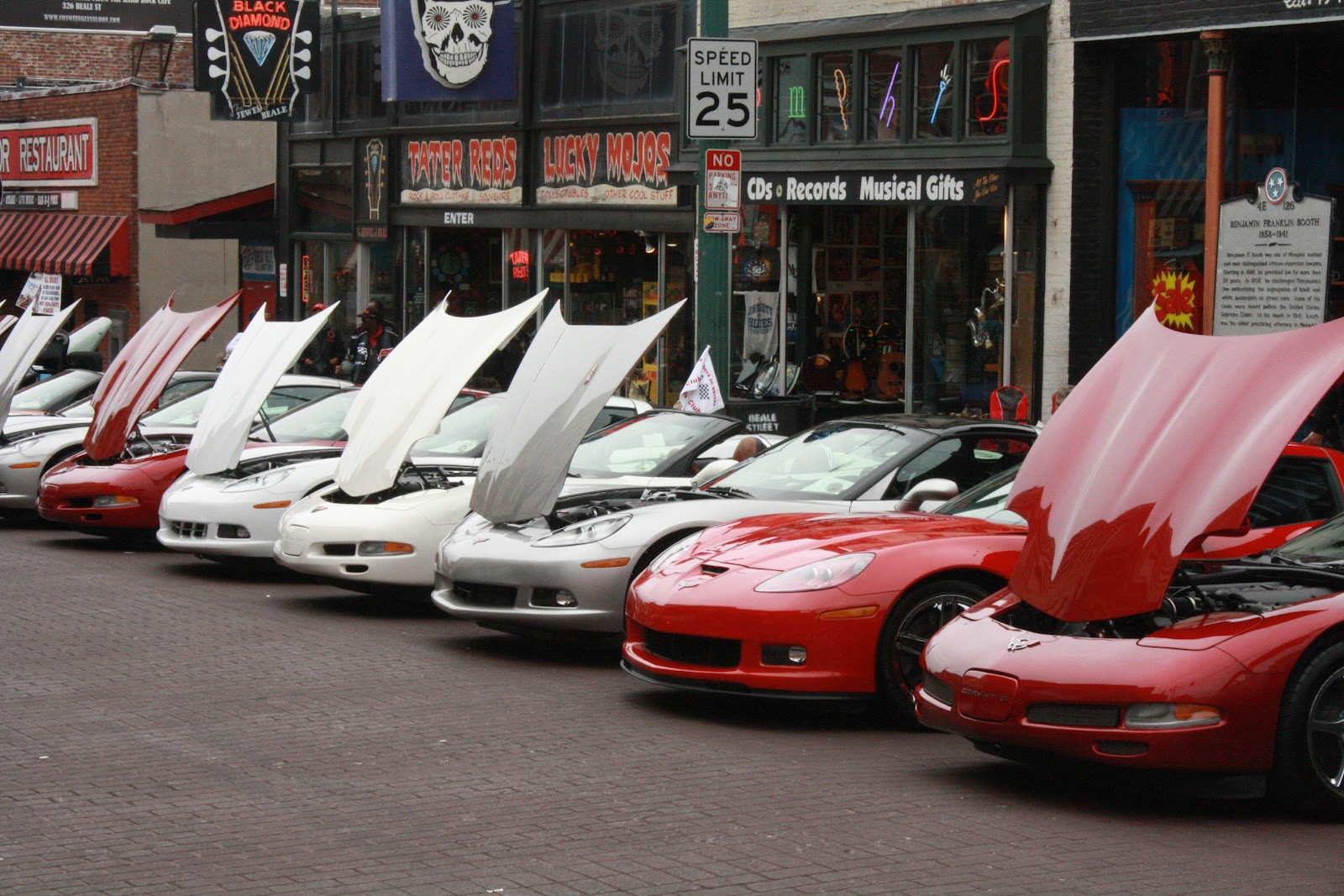
After a bit, I went out to wander Memphis just a little bit more. I wandered over to Beale Street, where I found myself in the middle of a Corvette enthusiast gathering. It was quite a site to see, but my time was short, and I couldn't dawdle.


I then moved on to get some photographs of the Mississippi River, which is, it must be said, one hell of a river. It was interesting, it must be said, to look across a river and know that I was seeing Arkansas - there are few places in my home state of California where you can know where one state ends and another begins just by looking at a natural boundary.


Finally, though, I headed back to the shuttle's stop, and got back to the hotel. I found myself Sitting in the shuttle with the wonderfully named Professor Paine. If only my friend Myrtle shock (aka Dr. Shock, on account of her Ph.D.) were there to meet him. Once at the hotel, I collected my belongings, and boarded another shuttle for the airport. However, as I boarded the shuttle back to the airport, I was happy to see that one of the Cocaine Anonymous folks was a dead ringer for Liam Neeson, were Liam Neeson a bearded, long-haired redneck.
Anyway, I got the the airport, and realized that I had not yet purchased a gift for Kaylia, so I got promptly on that, settling on a box of Moon Pies (I have always found them nasty, but Kaylia likes marshmallow more than I do). While doing this, I encountered a man who kept inadvertently knocking things off of shelves with his backpack. He and I got to talking, and it turned out that he was a film distributor from San Francisco who had been traveling the country to attend meetings with possible outlets for a film on the history of Timbuktu that had fallen into his company's hands. He had been in Memphis meeting with people in no way related to archaeology, when he heard that the SAA was there. However, he had no knowledge of how to reach anyone...and then he ran into an SAA member who also had no idea how to reach anyone at the SAA, so there's irony for you.
One pulled prok sandwich later, I had to move to get onto my plane. I was delighted to discover that there were only two people in my row - myself, and a fellow who looked for all of the world like John McCain. As the plane was loading, the honorable senator from Arizona pulled out a large, hardcover sex advice book, and began reading intently, which he continued doing until we touched down in Atlanta (our layover stop). Unlike the flight out, this one was uneventful, and I was able to finish reading my own book (Devil in a Blue Dress by Walter Mosley - I highly recommend it).
After we landed, and as we disembarked, it became clear that the former Republican nominee for president had to literally run to catch his connecting flight (perhaps to Wasilla Alaska?). And so he closed up his sex book and took off running as soon as we were off the plane (it was quite a sight to see, I assure you). I strolled at a leisurely towards my plane.
On my way to the plane, I was passed by a family of three - a mother and her two children (a boy of about ten years, and a girl in her early teens). The mother, a very attractive woman with an accent that I have to admit I found quite pleasant, said, rather loudly "well, all of this walking around is making my skirt ride up just ever so much!" Prompting the teenage daughter to say "Ma! What have I told you about too much information!" The son just giggled, whether because he thought it was funny, or out of embarrassment, I could not tell.
You know, it's a shame that sexy John McCain had to take off...I could have introduced the mother to him.
As I kept towards my plane's gate, I also saw a rather corpulent middle-aged white woman being pushed in a wheelchair by a young African American man. The young man had a bored look on his face, as the woman lectured on about how it is necessary to know your place in order to fit in and be happy. While the conversation may very well have had nothing to do with race, I must admit that the scene as I saw it seemed to conform to stereotypes. This, in turn, led me to wonder how often visitors to California see scenes that are not quite what they at first appear, and yet seem to conform to existing stereotypes.
Upon reaching my gate, I realized that I had an hour to kill before boarding. I was not yet hungry, but I realized that I had a four-to-five hour flight ahead of me, and therefore should probably eat. I made my way towards a nearby airport sandwich shop, and found myself at a table next to one filled by a group of female undergrad archaeology students, whose conversation was mostly gossip about who was dating who in their department, peppered with talk of good come-on lines for archaeologists. My favorite line: 'I have a recreated Navajo bow for projectile experimentation,would you like to come shoot it?'"
I am ashamed to admit that it took me about an hour before I realized the true potential for "bow job" jokes.
Finally, I got on my plane, and was on my way to San Francisco. Unlike my previous flights, I had little to report on this one. I was the only person in my row until the last hour or so of the flight, when a Peruvian archaeologist came over in order to work without being harassed by the person in the seat next to her. I finally arrived in San Francisco around 11:30, and got easily to my car, and then off to a friend's place for the night, heading back to Fresno in the morning.
And there ended what is likely my last SAA trip for quite a long time.
*It's like they're just 13-year-olds with jet engines.
**No, I'm not making this up.
So, that night I got to bed, fell asleep quickly, and, due to exhaustion, managed to sleep solidly the full night despite the immature pilots of Boeing 747s buzzing my hotel all night long*. This also despite the fact that the hotel began to fill up with the rather rowdy attendees of a party for 15-year-clean members of Cocaine Anonymous**.
The next morning, I took the shuttle over to the convention center again, knowing that I would only have a partial day in which to see what I could at the conference, as well as to take a quick look around Memphis in the daylight.
So, I started by going to the poster session at the conference. Posters, for those unaware, are a way for researchers to present their work without getting up and giving a talk. Although some posters could easily be turned into a 15 or 20 minute talk, most are not quite sufficient material for such a talk, and as a result are better served by the static display of the poster. A great advantage of posters is that the person who did the research is free to talk about it in a way that the people giving papers are not. As a result, the poster presenters are often quite busy discussing results and answering questions with the other conference attendees.
Several of the posters were quite good, but two in particular struck me. The first was from a graduate student at the University of Washington who was presenting on her work at Dutch colonies in the Spice Islands. Her work was interesting in its own right, but struck me especially because her findings (roughly - the Dutch were more acculturated by the people that they forced to work on their plantations than the people of the plantations were enculturated by the Dutch, and there was little effort to eliminate or alter the culture of the workers) held some interesting contrasts and parallels to the history of Spanish and later Mexican colonization of California.
The second noteworthy poster was from a young man whose institution I don't remember, but he was presenting on the work he is doing with sling stones. Sling stones are precisely what they sound like - rocks used in a sling (think of the weapon with which David is said to have killed Goliath). Slings were used throughout North America, but are rarely discussed by archaeologists, who generally focus on other projectile weapons - mostly arrows, darts, and spears. What struck me is that one of the sling stones that the presenter had made looked suspiciously like a common bi-conical stone found in Californian sites usually thought to have been a religious item and called a charm stone. Now, I am not saying that all, or even most, of these items were sling stones, but it is worth noting the similarities, and considering whether or not we may be routinely mistaking one artifact type for another.
After a bit, I went out to wander Memphis just a little bit more. I wandered over to Beale Street, where I found myself in the middle of a Corvette enthusiast gathering. It was quite a site to see, but my time was short, and I couldn't dawdle.


I then moved on to get some photographs of the Mississippi River, which is, it must be said, one hell of a river. It was interesting, it must be said, to look across a river and know that I was seeing Arkansas - there are few places in my home state of California where you can know where one state ends and another begins just by looking at a natural boundary.


Finally, though, I headed back to the shuttle's stop, and got back to the hotel. I found myself Sitting in the shuttle with the wonderfully named Professor Paine. If only my friend Myrtle shock (aka Dr. Shock, on account of her Ph.D.) were there to meet him. Once at the hotel, I collected my belongings, and boarded another shuttle for the airport. However, as I boarded the shuttle back to the airport, I was happy to see that one of the Cocaine Anonymous folks was a dead ringer for Liam Neeson, were Liam Neeson a bearded, long-haired redneck.
Anyway, I got the the airport, and realized that I had not yet purchased a gift for Kaylia, so I got promptly on that, settling on a box of Moon Pies (I have always found them nasty, but Kaylia likes marshmallow more than I do). While doing this, I encountered a man who kept inadvertently knocking things off of shelves with his backpack. He and I got to talking, and it turned out that he was a film distributor from San Francisco who had been traveling the country to attend meetings with possible outlets for a film on the history of Timbuktu that had fallen into his company's hands. He had been in Memphis meeting with people in no way related to archaeology, when he heard that the SAA was there. However, he had no knowledge of how to reach anyone...and then he ran into an SAA member who also had no idea how to reach anyone at the SAA, so there's irony for you.
One pulled prok sandwich later, I had to move to get onto my plane. I was delighted to discover that there were only two people in my row - myself, and a fellow who looked for all of the world like John McCain. As the plane was loading, the honorable senator from Arizona pulled out a large, hardcover sex advice book, and began reading intently, which he continued doing until we touched down in Atlanta (our layover stop). Unlike the flight out, this one was uneventful, and I was able to finish reading my own book (Devil in a Blue Dress by Walter Mosley - I highly recommend it).
After we landed, and as we disembarked, it became clear that the former Republican nominee for president had to literally run to catch his connecting flight (perhaps to Wasilla Alaska?). And so he closed up his sex book and took off running as soon as we were off the plane (it was quite a sight to see, I assure you). I strolled at a leisurely towards my plane.
On my way to the plane, I was passed by a family of three - a mother and her two children (a boy of about ten years, and a girl in her early teens). The mother, a very attractive woman with an accent that I have to admit I found quite pleasant, said, rather loudly "well, all of this walking around is making my skirt ride up just ever so much!" Prompting the teenage daughter to say "Ma! What have I told you about too much information!" The son just giggled, whether because he thought it was funny, or out of embarrassment, I could not tell.
You know, it's a shame that sexy John McCain had to take off...I could have introduced the mother to him.
As I kept towards my plane's gate, I also saw a rather corpulent middle-aged white woman being pushed in a wheelchair by a young African American man. The young man had a bored look on his face, as the woman lectured on about how it is necessary to know your place in order to fit in and be happy. While the conversation may very well have had nothing to do with race, I must admit that the scene as I saw it seemed to conform to stereotypes. This, in turn, led me to wonder how often visitors to California see scenes that are not quite what they at first appear, and yet seem to conform to existing stereotypes.
Upon reaching my gate, I realized that I had an hour to kill before boarding. I was not yet hungry, but I realized that I had a four-to-five hour flight ahead of me, and therefore should probably eat. I made my way towards a nearby airport sandwich shop, and found myself at a table next to one filled by a group of female undergrad archaeology students, whose conversation was mostly gossip about who was dating who in their department, peppered with talk of good come-on lines for archaeologists. My favorite line: 'I have a recreated Navajo bow for projectile experimentation,would you like to come shoot it?'"
I am ashamed to admit that it took me about an hour before I realized the true potential for "bow job" jokes.
Finally, I got on my plane, and was on my way to San Francisco. Unlike my previous flights, I had little to report on this one. I was the only person in my row until the last hour or so of the flight, when a Peruvian archaeologist came over in order to work without being harassed by the person in the seat next to her. I finally arrived in San Francisco around 11:30, and got easily to my car, and then off to a friend's place for the night, heading back to Fresno in the morning.
And there ended what is likely my last SAA trip for quite a long time.
*It's like they're just 13-year-olds with jet engines.
**No, I'm not making this up.
Wednesday, April 25, 2012
SAA Memphis Part 2 - It's Gettin' Real at the Convention Center
See Part 1 for the "story up to now..."
Okay, so there I was in Memphis, walking out of the hotel, trying to find the shuttle, only to be informed that the shuttle already left, a little bit early, already full. Three other archaeologists were already standing there - an older woman, a young professor, and an Albanian graduate student* (sounds like the setup to a joke, I know). So, the four of us decide to get a taxi. This worked out well enough, but the cab ride was considerably pricier than any of us expected (topping $30). Luckily, the professor had an expense account and so he covered it for all of us, which we all very much appreciated.
I got checked in to the conference, and high-tailed it over to my session just before it began. On the way, I ran into an old friend, Dave Robinson (the fellow for whom I have been doing faunal analysis), and we had a bit of a chat on the way in, and in between papers. Dave is quite brilliant, and I have always enjoyed talking shop with him.
Anyway, my session began, and, as the other speakers are presenting, I suddenly realize that there are a number of things that need to be changed about my paper. So, out comes my red pen (yes, I do typically carry one), and I begin re-writing sections on the print-out that I have. I am becoming increasingly nervous as I go, and realizing that the Powerpoint presentation that I had created and sent to the symposium organizer bears only a vague similarity to the paper as it now exists. Earlier than I had been scheduled, the organizer announces that one of the papers had been cancelled, and as such I am now up.
I am horribly nervous, panicked, and not wanting to go up. I look around the room, and it has a number of brilliant archaeologists, almost every colleague who I hold in high esteem: Lynne Gamble, Terry Joslin, Dave Robinson, Jennifer Perry, Amy Gusick, Bill Hildebrandt (who also runs one of my company's main competitors), John Johnson, and my mentor, Michael Glassow.
Shit.
Well, there was nothing else for it. I began talking. As I was in the middle of modifying the damn paper when I was called up, I had to fudge a few sections, explaining the concepts and data without having a good script from which to work. I was able to ease things along by cracking a few jokes about the microscopically small font size on some of my Powerpoint slides, and I was able to make the Powerpoint presentation work with what I had. I was very unhappy with the paper when I gave it, but I managed to at least get through the presentation without hyperventillating. As always when I do these talks, I sat down believing that I had blown my credibility with everyone in the room. I was feeling pretty terrible.
I was the last speaker, so I fully expected to slink out unnoticed. But then one of the more senior archaeologists accosted me. He came towards me, and instead of the upbraiding that I was expecting, he enthused "that was great! Some of what you were talking about is stuff that always bothered me, and I am glad to see that someone else also saw it...and the approach you took was pretty cool! Here, take my card, I want you to email a copy of that paper to me!"
I was a bit confused, but played along.
John Johnson then spoke with me, and described the research that he would like to do on the subject, while complimenting what I had said. Now, John is probably the absolute nicest guy in Anthropology (he is at least in the running along with Michael Jochim), so I half-way suspect that he was just being polite, but still, he seemed enthusiastic.
Dave also was enthusiastic, which helped.
And then I ran into someone who was now with Harvard's Peabody Museum, but who, 30 years ago, had worked in the same region where I did my Masters thesis research. He told me that he had come to the session because he had read the paper I had published recently, and really wanted to hear what I had to say about this other topic. So, that was pretty damn cool. Anyway, he and I spoke about our mutual research interests for a little while. And then I realized that my boss, who knew the fellow from Harvard, had been in the room during the presentation. However, she was enthusiastic and seemed to feel that I had done quite well.
So, all in all, I am going to call this a win.
I then headed out, and ran into a friend from graduate school who I had also worked with at my first full-time CRM job. He and I headed out to lunch, and spent some time talking business, research, and about the academic job market. It was nice, but we were both eager, after lunch, to get back to the conference. He went to attend a paper, and I went to attend another session, but was stopped on the way by another old friend who now worked for the Forest Service. Being as how part of how my company justifies sending us out to these conferences is business networking, and I really just wanted to talk with my friend, I allowed myself to get distracted, and we both made sure to mingle business talk with our catching-up. We parted company, and I headed up to the book room, where I ran into more old friends, and a couple of former coworkers.
I then headed out to the lobby, and had my only bad interaction with another archaeologist at this conference. I should explain that it is not uncommon for academic archaeologists to look down on CRM. This is less common than it used to be, as an increasing number of academic archaeologists have become involved in CRM work, but it is still not rare. This particular fellow told me that he was on the faculty of a university-not-to-be-named, and then looked at my name badge (our name badges bore the names of our employers), sniffed, and said, "oh, well...I see that you're still doing CRM" with a tone that seemed to say "you phony archaeologists are so adorable, but you'll never be in the same league as us grown-ups." He made a few minor disparaging comments, and I pushed back a bit by asking him questions about how long he'd been unemployed before finally getting his current position, asking about the vicious politics of tenure, asking about the family that I was well aware he both wanted and didn't have because of the way his career had been going, and then brought up my retirement plan. Yeah, it was petty, I was being an ass, but I have long since grown tired of this attitude.
After that, I headed over towards another talk, only to be waylaid by a former boss who is also tied into a couple of my company's current projects. I always liked this guy, and I had a good business reason for sitting and talking with him for a bit (in fact, it arguably would have been irresponsible for me to not sit and talk with him), so I did so. We talked shop a little bit (I was very cautious to avoid saying anything or inquiring about anything above my pay grade, and to not say anything that would have been considered in any way inappropriate by my current boss, so as not to create any trouble for my boss). We also talked a bit about why I left. When I left, I had told him that it was for family reasons, and because I was constantly being required to work untenably long hours and be away from home far too often, which was true to an extent. However, a big part of the reason is that a person had been put in charge of a huge project, about whom the best that I can say is that I would not weep had I discovered that the CIA kidnapped him and used him for experiments involving weaponized ebola.
My former boss then told me that I wasn't alone. Apparently a number of people jumped ship when this guy was there. Finally, though, the guy did enough damage, and my former boss had enough. He put one of the former subordinates in the place of the now ex-project manager, and she has been running the project quite successfully, and from what I have heard, the employees under her have developed alot of respect for her and are quite happy with her as their new supervisor.
It was oddly satisfying to hear that.
By the time we finished up, the day's papers were over. Normally, I would have gone to find some people to have dinner with. But I was only going to be in Memphis for this night, so I decided to grab my camera and go wandering about.
Of course, it started raining. I bought an umbrella, and proceeded to wander Memphis, seeing what I could see. Yeah, it was cold, yeah, I was wet, yeah, I couldn't use my camera without pulling it out of the case and getting it soaked. But I didn't care. I was out, exploring a new city in a new region, and I was having fun.
I realized around 9:00 that I hadn't yet had dinner, and most of the non-pricey places had closed up, so I ended up going to a fast food chicken place that I had not previously heard of, got some chicken, fried okra (I don't care what anyone else says, I enjoy fried okra, and have ever since my grandmother introduce me to it when I was a kid), and a biscuit, and had my dinner while I waited for the shuttle back to my hotel.
As I sat at the shuttle stop waiting, I fell into conversation with a very grizzled fellow who, as it turned out, was the State Historic Preservation Officer for Guam (despite being a territory and not a state, Guam's guy is still called a STATE Historic Preservation Officer...go figure). He and I talked shop for a while, and while it wasn't the most enjoyable conversation I have ever had (he was a remarkably frustrated man, though it sounded as if he had cause to be), it was interesting.
Finally, the shuttle arrived, we got to the hotel, I trundled up to my room, got the malfunctioning door handle to work after a couple of tries, and then went to bed. I was so astoundingly exhausted that I slept solidly despite the 747s passing overhead causing the building to shake.
*I suddenly felt very awkward, as if this guy would somehow know that whenever I need to pull up some random nationality for a fictional character or an absurdist joke involving cab drivers (as overly-specific as it may sound, I crack these jokes quite often), I always choose "Albanian." Well, regardless, I ran into him a few more times, and found that I enjoyed his company, so there you go.
Okay, so there I was in Memphis, walking out of the hotel, trying to find the shuttle, only to be informed that the shuttle already left, a little bit early, already full. Three other archaeologists were already standing there - an older woman, a young professor, and an Albanian graduate student* (sounds like the setup to a joke, I know). So, the four of us decide to get a taxi. This worked out well enough, but the cab ride was considerably pricier than any of us expected (topping $30). Luckily, the professor had an expense account and so he covered it for all of us, which we all very much appreciated.
I got checked in to the conference, and high-tailed it over to my session just before it began. On the way, I ran into an old friend, Dave Robinson (the fellow for whom I have been doing faunal analysis), and we had a bit of a chat on the way in, and in between papers. Dave is quite brilliant, and I have always enjoyed talking shop with him.
Anyway, my session began, and, as the other speakers are presenting, I suddenly realize that there are a number of things that need to be changed about my paper. So, out comes my red pen (yes, I do typically carry one), and I begin re-writing sections on the print-out that I have. I am becoming increasingly nervous as I go, and realizing that the Powerpoint presentation that I had created and sent to the symposium organizer bears only a vague similarity to the paper as it now exists. Earlier than I had been scheduled, the organizer announces that one of the papers had been cancelled, and as such I am now up.
I am horribly nervous, panicked, and not wanting to go up. I look around the room, and it has a number of brilliant archaeologists, almost every colleague who I hold in high esteem: Lynne Gamble, Terry Joslin, Dave Robinson, Jennifer Perry, Amy Gusick, Bill Hildebrandt (who also runs one of my company's main competitors), John Johnson, and my mentor, Michael Glassow.
Shit.
Well, there was nothing else for it. I began talking. As I was in the middle of modifying the damn paper when I was called up, I had to fudge a few sections, explaining the concepts and data without having a good script from which to work. I was able to ease things along by cracking a few jokes about the microscopically small font size on some of my Powerpoint slides, and I was able to make the Powerpoint presentation work with what I had. I was very unhappy with the paper when I gave it, but I managed to at least get through the presentation without hyperventillating. As always when I do these talks, I sat down believing that I had blown my credibility with everyone in the room. I was feeling pretty terrible.
I was the last speaker, so I fully expected to slink out unnoticed. But then one of the more senior archaeologists accosted me. He came towards me, and instead of the upbraiding that I was expecting, he enthused "that was great! Some of what you were talking about is stuff that always bothered me, and I am glad to see that someone else also saw it...and the approach you took was pretty cool! Here, take my card, I want you to email a copy of that paper to me!"
I was a bit confused, but played along.
John Johnson then spoke with me, and described the research that he would like to do on the subject, while complimenting what I had said. Now, John is probably the absolute nicest guy in Anthropology (he is at least in the running along with Michael Jochim), so I half-way suspect that he was just being polite, but still, he seemed enthusiastic.
Dave also was enthusiastic, which helped.
And then I ran into someone who was now with Harvard's Peabody Museum, but who, 30 years ago, had worked in the same region where I did my Masters thesis research. He told me that he had come to the session because he had read the paper I had published recently, and really wanted to hear what I had to say about this other topic. So, that was pretty damn cool. Anyway, he and I spoke about our mutual research interests for a little while. And then I realized that my boss, who knew the fellow from Harvard, had been in the room during the presentation. However, she was enthusiastic and seemed to feel that I had done quite well.
So, all in all, I am going to call this a win.
I then headed out, and ran into a friend from graduate school who I had also worked with at my first full-time CRM job. He and I headed out to lunch, and spent some time talking business, research, and about the academic job market. It was nice, but we were both eager, after lunch, to get back to the conference. He went to attend a paper, and I went to attend another session, but was stopped on the way by another old friend who now worked for the Forest Service. Being as how part of how my company justifies sending us out to these conferences is business networking, and I really just wanted to talk with my friend, I allowed myself to get distracted, and we both made sure to mingle business talk with our catching-up. We parted company, and I headed up to the book room, where I ran into more old friends, and a couple of former coworkers.
I then headed out to the lobby, and had my only bad interaction with another archaeologist at this conference. I should explain that it is not uncommon for academic archaeologists to look down on CRM. This is less common than it used to be, as an increasing number of academic archaeologists have become involved in CRM work, but it is still not rare. This particular fellow told me that he was on the faculty of a university-not-to-be-named, and then looked at my name badge (our name badges bore the names of our employers), sniffed, and said, "oh, well...I see that you're still doing CRM" with a tone that seemed to say "you phony archaeologists are so adorable, but you'll never be in the same league as us grown-ups." He made a few minor disparaging comments, and I pushed back a bit by asking him questions about how long he'd been unemployed before finally getting his current position, asking about the vicious politics of tenure, asking about the family that I was well aware he both wanted and didn't have because of the way his career had been going, and then brought up my retirement plan. Yeah, it was petty, I was being an ass, but I have long since grown tired of this attitude.
After that, I headed over towards another talk, only to be waylaid by a former boss who is also tied into a couple of my company's current projects. I always liked this guy, and I had a good business reason for sitting and talking with him for a bit (in fact, it arguably would have been irresponsible for me to not sit and talk with him), so I did so. We talked shop a little bit (I was very cautious to avoid saying anything or inquiring about anything above my pay grade, and to not say anything that would have been considered in any way inappropriate by my current boss, so as not to create any trouble for my boss). We also talked a bit about why I left. When I left, I had told him that it was for family reasons, and because I was constantly being required to work untenably long hours and be away from home far too often, which was true to an extent. However, a big part of the reason is that a person had been put in charge of a huge project, about whom the best that I can say is that I would not weep had I discovered that the CIA kidnapped him and used him for experiments involving weaponized ebola.
My former boss then told me that I wasn't alone. Apparently a number of people jumped ship when this guy was there. Finally, though, the guy did enough damage, and my former boss had enough. He put one of the former subordinates in the place of the now ex-project manager, and she has been running the project quite successfully, and from what I have heard, the employees under her have developed alot of respect for her and are quite happy with her as their new supervisor.
It was oddly satisfying to hear that.
By the time we finished up, the day's papers were over. Normally, I would have gone to find some people to have dinner with. But I was only going to be in Memphis for this night, so I decided to grab my camera and go wandering about.
Of course, it started raining. I bought an umbrella, and proceeded to wander Memphis, seeing what I could see. Yeah, it was cold, yeah, I was wet, yeah, I couldn't use my camera without pulling it out of the case and getting it soaked. But I didn't care. I was out, exploring a new city in a new region, and I was having fun.
I realized around 9:00 that I hadn't yet had dinner, and most of the non-pricey places had closed up, so I ended up going to a fast food chicken place that I had not previously heard of, got some chicken, fried okra (I don't care what anyone else says, I enjoy fried okra, and have ever since my grandmother introduce me to it when I was a kid), and a biscuit, and had my dinner while I waited for the shuttle back to my hotel.
As I sat at the shuttle stop waiting, I fell into conversation with a very grizzled fellow who, as it turned out, was the State Historic Preservation Officer for Guam (despite being a territory and not a state, Guam's guy is still called a STATE Historic Preservation Officer...go figure). He and I talked shop for a while, and while it wasn't the most enjoyable conversation I have ever had (he was a remarkably frustrated man, though it sounded as if he had cause to be), it was interesting.
Finally, the shuttle arrived, we got to the hotel, I trundled up to my room, got the malfunctioning door handle to work after a couple of tries, and then went to bed. I was so astoundingly exhausted that I slept solidly despite the 747s passing overhead causing the building to shake.
*I suddenly felt very awkward, as if this guy would somehow know that whenever I need to pull up some random nationality for a fictional character or an absurdist joke involving cab drivers (as overly-specific as it may sound, I crack these jokes quite often), I always choose "Albanian." Well, regardless, I ran into him a few more times, and found that I enjoyed his company, so there you go.
Monday, April 23, 2012
SAA Memphis, Part 1 - Getting there is Half the Fun?
As I write this, on Saturday night, I am cramped into an awkward position on a Boeing 727 on my way back to the San Francisco Airport. I have attended what is likely to be my last meeting for a while of the Society for American Archaeology. As much as I would love to go again, a combination of changes in my life (impending fatherhood, and supporting my fiance financially) puts me into a position where there are other things that I wish to do with my money, while my career path removes much of the motivation (being a CRM archaeologist rather than an academic archaeologist means that I get significantly more out of my regional conference - the Society for California Archaeology annual meeting - than I do out of the SAA's meetings, and for this reason I have only attended two SAA meetings in the last seven years. I wouldn't have gone this year were it not for two factors: 1) my employer fotted the bill, which they had not compelling reason to do, but my company's owners being basically good people who care about their employees, they were willing to; and 2) I was presenting a paper, and while I could have sent it to be read by someone else, I very much wanted to be the one to do so, and for reasons that will become clear later, I am very glad that I did.
The trip started off poorly. I slept poorly the night before due to some unexpected (and unexpectedly late) company, so things were off to a great start. In order to save my employer money (they were good enough to pay my way, I figured that I should be decent enough to use their money with some discretion), I flew out of San Francisco, rather than Fresno. This meant that I had to drive 3 1/2 hours to San Francisco, which on a weekday during mid-morning and early afternoon would normally have been a long, but easy, drive. South of Modesto, a collision earlier in the day had closed off a lane of traffic, and though the vehicle had been cleared and the occupants taken for medical care, the Highway Patrol still had the lane closed down. So, I was concerned about my ability to get to the airport in time. And then I hit a toll bridge that I wasn't expecting, and therefore didn't have the toll for, meaning that I now owe the state $30 to be payed in a few weeks rather than $5 paid then. Argh.
I did, however, manage to arrive only a few minutes behind schedule. However, I quickly discovered that the long term parking lot was completely full. I discovered this not through signage, or anyone standing at the gate to let me know (there were airport parking employees standing at the gate, but they seemed content to allow cars to enter the lot without warning), but when I had traveled all throughout the parking lot and found not a single space available. As I was trying to find my way out of the parking lot - which is in many respects rather maze-like in it's traffic design - I was trailed for a time by an airport buss, which after a bit honked it's horn at me. I stopped, and a middle-aged Asian man with a thick accent left the driver's seat, walked over to me and shouted "The parking lot is full!"
I looked at him, and said the only thing I could think of: "Yes, I had noticed that."
"The parking lot is full!" he shouted at me.
"Yes, we've established this. I am not trying to argue with you."
He looked at me as if I were some sort of half-wit child that he had been burdened with by unkind relatives. "The parking lot is full! You have to leave!"
Now I was getting irritated, and so, getting a bit testy, " said through gritted teeth "Yeah, I know that the damn lot is full, stop shouting that! Where am I supposed to go?"
He glared at me angrily, and shouted "Why didn't you get a flyer from the people at the exit!"
"Because I didn't know that the people from the exit had flyers!"
"Well they do! You have to go get one, now!" He was getting louder and angrier.
Now, I began shouting back "I'll go get a fucking flyer! But maybe you should actually, you know, let people know before YOU start screaming at them!"
He backed towards his van, and shouted "You get the flyer, and go where it tells you to!"
"Yeah, I'm fucking leaving!"
And with that, I headed to the exit, which is right next to the entrance, where the guy standing there who ignored me as I drove in handed me a flyer explaining that I had to go to the alternative lot for parking. I got the the alternative lot, where a very pleasant, calm man explained where the open spaces were. I proceeded to park, get on a shuttle, and get to the terminal.
At the terminal, I quickly discovered that my flight had been delayed. This would not have been a problem, except that to get to my final destination (Memphis, Tennessee), I had to catch a connecting flight in Atlanta, Georgia. The delay meant that I would not catch my connecting flight, and the Airtran, the airline for which I had my tickets, had no further flights from Atlanta to Memphis until the following morning, meaning that (assuming no further delays) I would not only have to pay for a hotel in Atlanta (Airtran made it clear that they weren't going to help), AND I wouldn't arrive in Memphis until 10 AM the next day. The problem is that I was scheduled to speak at 10:45, and it was unlikely in the extreme that I would make it to the conference center on time.
My only option was to buy a ticket on another airline to get where I was headed. But, as described in the first paragraph, I could not afford to buy another airline ticket without taking a financial hit that would hurt me and/or my fiance.
I called one of the owners of my company, explained the situation, and said that I couldn't afford the ticket. To my surprise, his response was "get yourself there, let me worry about the money."
Seriously, I couldn't love my current job any more if it began slipping me ecstasy in the coffee. These are great people to work for.
So, I got online, and quickly discovered that all flights to Memphis, even indirect ones with layovers were sold out. And then, the data on my computer screen shifted, and one was available on US Airways. Someone had cancelled...and the ticket had re-posted.
Things were looking up.
I ran to the US Airways counter - which, it turned out, was about twenty feet from where I was sitting, and I bought the ticket. It was even an emergency exit row, meaning that even my gangly long legs would have sufficient room.
Hell yeah, things were looking very much up.
I got through security (which, incidentally, is getting creepier every time I fly), and got to the gate just a few minutes before boarding began.
On the next plane, the three largest men on the flight were all put together at the exit. On the one hand, this meant we all had plenty of leg room, but it also meant that we were bashing each other with our elbows and shoulders every time that we moved. At first, the biggest of us, a large man from Virginia, made his displeasure at having to share space with other big guys clear. He then put in his headphones and did his best to ignore me and the other guy. The other fellow, who lives in Washington (though his accent marked him as a native New Yorker) and I talked for a bit, and he was quite pleasant. He then used the in-flight Wi-fi to listen to a hockey game on his earphones. I took out my paper and computer, and began making revisions (actually, I substantially re-structured and re-wrote the paper). After I had finished this, the Virginian took out his earphones and asked what I had been working on, so I explained it to him, which led to more questions. We talked on and off for the rest of the flight, but by the end, I had learned a good deal about his business (he is a software engineer who is engaged in work on cloud-based applications), and we had talked about mutual areas of scientific interests. Despite my initial impression, he was a fantastically nice guy, and extremely intelligent and funny.
After we had been in the air for about an hour, we hit a pocket of turbulence. Not too terribly unusual, and I have been through worse, but we were all asked to fasten our seat belts. And then the turbulence got even worse, the worst I have, to date, ever been in. And the flight crew strapped themselves in and announced over the speakers that we were no longer in normal turbulence. This was, in fact, an emergency situation, and we should all remain in our seats and keep calm.
I have never been one to need a barf bag. But on this flight, I was beginning to see the wisdom of them. the emergency situation lasted for about an hour, though the worst of the turbulence was gone in about twenty minutes.
Anyway, we eventually landed, the three of us exit row men shook hands and parted ways, and I had time to have dinner before getting onto my next plane.
Boarding the next flight, I discovered that there were only two people in my row: myself, and a fellow wearing a t-shirt and shorts, and carrying a pamphlet of Bible verses. After we were in the air, the crew came by with the drink cart, and I got my usual Diet Coke. The fellow with the Bible pamphlet, however, got a can of Red Bull and several small bottles of Vodka. The flight attendant wanted to stop him at two, but after he assured her that his girlfriend was going to pick him up, and that therefore he would not be driving drunk, he was able to negotiate his way into a few more bottles. And so, on the flight, I worked on my paper further as the guy in the seat next to me proceeded to get hammered while reading Bible verses. even after the bottles had been taken away, I could smell the vodka coming off of this guy as he read the words of Luke.
I can't make crap like this up.
We finally arrived in Memphis just before midnight local time. By this point, I was tired and worn out from traveling, and stressed over the paper that I was increasingly worried about. I called my hotel to find out if they had a shuttle or if I should hire a taxi. I was assured that a shuttle would be there for me soon, but it took over half an hour (the hotel was a five-minute drive away). I finally arrived at the hotel after midnight, and proceeded to try to check in. The man at the desk, a preternaturally patient and professional Indian gentleman, politely informed me that my card had been denied when I tried ot pay for the room.
What the fuck?
I called my bank (thankfully they have 24 hour customer service), and spent most of the next hour on hold while the rep contacted fraud prevention to find out what was going on. Turned out that my card was suspended when it was discovered that charges had been made in two different states on the same day. This looked like either A) my card number had been stolen, or B) I was flying to different fucking airports like I had told my bank I would be doing to prevent this sort of nonsense. Anyway, with that cleared up, I was able to check in to my hotel room. The man at the desk had given me a key, and I proceeded towards the room that he had told me to head to.
Once I reached my door, I slid the key card in, the green light on the door handle shown, and I turned the handle only to discover that the room had been dead-bolted from inside.
I headed back to the elevator, stepped inside, pressed the button for the lobby, the doors closed and...nothing. I hit "Door Open", and the doors opened, I stepped out, let the doors closed, pressed the button, the doors opened, I stepped inside, hit the button for the lobby again, the doors again closed, and...nothing.
I opened the doors again, and went looking for the stairs. The hotel had a courtyard design, with a huge open central space, and the rooms along the sides. The stars were in a shaft that had been designed to look like a support and not a shaft containing a staircase. On the one hand, this gave the hotel a clear, open feeling. On the other hand, it made the stairs difficult to locate for a sleep-deprived conference goer who was already having a frustrating day. Still, I eventually found them went back to the front desk, and explained what had happened. The man at the desk, clearly embarrassed, assigned me another room. I went up to it, tried the key card, and the door wouldn't open. The door wasn't dead-bolted, it felt different than that, but it wouldn't open. I went back to the desk, and the fellow accompanied me back to the room, where we finally got the door open - turned out that the mechanism was getting worn out, and that if you didn't turn it in just the right way, you wouldn't get the door open. Normally, I would have requested another room, but at this point I was simply grateful to be at a hotel room in Memphis, and I went right in.
As tired as I was, before going to bed, I had to check my email. And it's a good thing that I did, because I had a notice informing me that, because I had not been on the outgoing Airtran flight, my return flight might be cancelled. So, I had to call Expedia, through whom I had booked the flight, and spent the next 90 minutes on the phone with them. I called four times - each of these times I was put on hold while the rep contacted their supervisor. And each of the first three times, as I waited on hold, I was hung up on. The fourth time I had to wait an extra long time to talk to a rep because, apparently, 3 am central time is the popular time to call Expedia's customer (dis)service line. Finally, on the fourth call, I spoke with someone who was able to get the mess straightened out, and made sure that my return flight was confirmed.
So, closing in on 4 am, I went to bed. By this time, however, I was so astoundingly stressed out that I couldn't sleep. So, I just lay there for a few hours, and then got up, showered, shaved, got dressed, went to print up my paper, and then went downstairs to head to the conference.
The trip started off poorly. I slept poorly the night before due to some unexpected (and unexpectedly late) company, so things were off to a great start. In order to save my employer money (they were good enough to pay my way, I figured that I should be decent enough to use their money with some discretion), I flew out of San Francisco, rather than Fresno. This meant that I had to drive 3 1/2 hours to San Francisco, which on a weekday during mid-morning and early afternoon would normally have been a long, but easy, drive. South of Modesto, a collision earlier in the day had closed off a lane of traffic, and though the vehicle had been cleared and the occupants taken for medical care, the Highway Patrol still had the lane closed down. So, I was concerned about my ability to get to the airport in time. And then I hit a toll bridge that I wasn't expecting, and therefore didn't have the toll for, meaning that I now owe the state $30 to be payed in a few weeks rather than $5 paid then. Argh.
I did, however, manage to arrive only a few minutes behind schedule. However, I quickly discovered that the long term parking lot was completely full. I discovered this not through signage, or anyone standing at the gate to let me know (there were airport parking employees standing at the gate, but they seemed content to allow cars to enter the lot without warning), but when I had traveled all throughout the parking lot and found not a single space available. As I was trying to find my way out of the parking lot - which is in many respects rather maze-like in it's traffic design - I was trailed for a time by an airport buss, which after a bit honked it's horn at me. I stopped, and a middle-aged Asian man with a thick accent left the driver's seat, walked over to me and shouted "The parking lot is full!"
I looked at him, and said the only thing I could think of: "Yes, I had noticed that."
"The parking lot is full!" he shouted at me.
"Yes, we've established this. I am not trying to argue with you."
He looked at me as if I were some sort of half-wit child that he had been burdened with by unkind relatives. "The parking lot is full! You have to leave!"
Now I was getting irritated, and so, getting a bit testy, " said through gritted teeth "Yeah, I know that the damn lot is full, stop shouting that! Where am I supposed to go?"
He glared at me angrily, and shouted "Why didn't you get a flyer from the people at the exit!"
"Because I didn't know that the people from the exit had flyers!"
"Well they do! You have to go get one, now!" He was getting louder and angrier.
Now, I began shouting back "I'll go get a fucking flyer! But maybe you should actually, you know, let people know before YOU start screaming at them!"
He backed towards his van, and shouted "You get the flyer, and go where it tells you to!"
"Yeah, I'm fucking leaving!"
And with that, I headed to the exit, which is right next to the entrance, where the guy standing there who ignored me as I drove in handed me a flyer explaining that I had to go to the alternative lot for parking. I got the the alternative lot, where a very pleasant, calm man explained where the open spaces were. I proceeded to park, get on a shuttle, and get to the terminal.
At the terminal, I quickly discovered that my flight had been delayed. This would not have been a problem, except that to get to my final destination (Memphis, Tennessee), I had to catch a connecting flight in Atlanta, Georgia. The delay meant that I would not catch my connecting flight, and the Airtran, the airline for which I had my tickets, had no further flights from Atlanta to Memphis until the following morning, meaning that (assuming no further delays) I would not only have to pay for a hotel in Atlanta (Airtran made it clear that they weren't going to help), AND I wouldn't arrive in Memphis until 10 AM the next day. The problem is that I was scheduled to speak at 10:45, and it was unlikely in the extreme that I would make it to the conference center on time.
My only option was to buy a ticket on another airline to get where I was headed. But, as described in the first paragraph, I could not afford to buy another airline ticket without taking a financial hit that would hurt me and/or my fiance.
I called one of the owners of my company, explained the situation, and said that I couldn't afford the ticket. To my surprise, his response was "get yourself there, let me worry about the money."
Seriously, I couldn't love my current job any more if it began slipping me ecstasy in the coffee. These are great people to work for.
So, I got online, and quickly discovered that all flights to Memphis, even indirect ones with layovers were sold out. And then, the data on my computer screen shifted, and one was available on US Airways. Someone had cancelled...and the ticket had re-posted.
Things were looking up.
I ran to the US Airways counter - which, it turned out, was about twenty feet from where I was sitting, and I bought the ticket. It was even an emergency exit row, meaning that even my gangly long legs would have sufficient room.
Hell yeah, things were looking very much up.
I got through security (which, incidentally, is getting creepier every time I fly), and got to the gate just a few minutes before boarding began.
On the next plane, the three largest men on the flight were all put together at the exit. On the one hand, this meant we all had plenty of leg room, but it also meant that we were bashing each other with our elbows and shoulders every time that we moved. At first, the biggest of us, a large man from Virginia, made his displeasure at having to share space with other big guys clear. He then put in his headphones and did his best to ignore me and the other guy. The other fellow, who lives in Washington (though his accent marked him as a native New Yorker) and I talked for a bit, and he was quite pleasant. He then used the in-flight Wi-fi to listen to a hockey game on his earphones. I took out my paper and computer, and began making revisions (actually, I substantially re-structured and re-wrote the paper). After I had finished this, the Virginian took out his earphones and asked what I had been working on, so I explained it to him, which led to more questions. We talked on and off for the rest of the flight, but by the end, I had learned a good deal about his business (he is a software engineer who is engaged in work on cloud-based applications), and we had talked about mutual areas of scientific interests. Despite my initial impression, he was a fantastically nice guy, and extremely intelligent and funny.
After we had been in the air for about an hour, we hit a pocket of turbulence. Not too terribly unusual, and I have been through worse, but we were all asked to fasten our seat belts. And then the turbulence got even worse, the worst I have, to date, ever been in. And the flight crew strapped themselves in and announced over the speakers that we were no longer in normal turbulence. This was, in fact, an emergency situation, and we should all remain in our seats and keep calm.
I have never been one to need a barf bag. But on this flight, I was beginning to see the wisdom of them. the emergency situation lasted for about an hour, though the worst of the turbulence was gone in about twenty minutes.
Anyway, we eventually landed, the three of us exit row men shook hands and parted ways, and I had time to have dinner before getting onto my next plane.
Boarding the next flight, I discovered that there were only two people in my row: myself, and a fellow wearing a t-shirt and shorts, and carrying a pamphlet of Bible verses. After we were in the air, the crew came by with the drink cart, and I got my usual Diet Coke. The fellow with the Bible pamphlet, however, got a can of Red Bull and several small bottles of Vodka. The flight attendant wanted to stop him at two, but after he assured her that his girlfriend was going to pick him up, and that therefore he would not be driving drunk, he was able to negotiate his way into a few more bottles. And so, on the flight, I worked on my paper further as the guy in the seat next to me proceeded to get hammered while reading Bible verses. even after the bottles had been taken away, I could smell the vodka coming off of this guy as he read the words of Luke.
I can't make crap like this up.
We finally arrived in Memphis just before midnight local time. By this point, I was tired and worn out from traveling, and stressed over the paper that I was increasingly worried about. I called my hotel to find out if they had a shuttle or if I should hire a taxi. I was assured that a shuttle would be there for me soon, but it took over half an hour (the hotel was a five-minute drive away). I finally arrived at the hotel after midnight, and proceeded to try to check in. The man at the desk, a preternaturally patient and professional Indian gentleman, politely informed me that my card had been denied when I tried ot pay for the room.
What the fuck?
I called my bank (thankfully they have 24 hour customer service), and spent most of the next hour on hold while the rep contacted fraud prevention to find out what was going on. Turned out that my card was suspended when it was discovered that charges had been made in two different states on the same day. This looked like either A) my card number had been stolen, or B) I was flying to different fucking airports like I had told my bank I would be doing to prevent this sort of nonsense. Anyway, with that cleared up, I was able to check in to my hotel room. The man at the desk had given me a key, and I proceeded towards the room that he had told me to head to.
Once I reached my door, I slid the key card in, the green light on the door handle shown, and I turned the handle only to discover that the room had been dead-bolted from inside.
I headed back to the elevator, stepped inside, pressed the button for the lobby, the doors closed and...nothing. I hit "Door Open", and the doors opened, I stepped out, let the doors closed, pressed the button, the doors opened, I stepped inside, hit the button for the lobby again, the doors again closed, and...nothing.
I opened the doors again, and went looking for the stairs. The hotel had a courtyard design, with a huge open central space, and the rooms along the sides. The stars were in a shaft that had been designed to look like a support and not a shaft containing a staircase. On the one hand, this gave the hotel a clear, open feeling. On the other hand, it made the stairs difficult to locate for a sleep-deprived conference goer who was already having a frustrating day. Still, I eventually found them went back to the front desk, and explained what had happened. The man at the desk, clearly embarrassed, assigned me another room. I went up to it, tried the key card, and the door wouldn't open. The door wasn't dead-bolted, it felt different than that, but it wouldn't open. I went back to the desk, and the fellow accompanied me back to the room, where we finally got the door open - turned out that the mechanism was getting worn out, and that if you didn't turn it in just the right way, you wouldn't get the door open. Normally, I would have requested another room, but at this point I was simply grateful to be at a hotel room in Memphis, and I went right in.
As tired as I was, before going to bed, I had to check my email. And it's a good thing that I did, because I had a notice informing me that, because I had not been on the outgoing Airtran flight, my return flight might be cancelled. So, I had to call Expedia, through whom I had booked the flight, and spent the next 90 minutes on the phone with them. I called four times - each of these times I was put on hold while the rep contacted their supervisor. And each of the first three times, as I waited on hold, I was hung up on. The fourth time I had to wait an extra long time to talk to a rep because, apparently, 3 am central time is the popular time to call Expedia's customer (dis)service line. Finally, on the fourth call, I spoke with someone who was able to get the mess straightened out, and made sure that my return flight was confirmed.
So, closing in on 4 am, I went to bed. By this time, however, I was so astoundingly stressed out that I couldn't sleep. So, I just lay there for a few hours, and then got up, showered, shaved, got dressed, went to print up my paper, and then went downstairs to head to the conference.
Friday, April 20, 2012
The Talk is Over, on to the Next One
By the time this posts, I will have delivered a paper at one of the symposiums (symposia?) at the Society For American Archaeology's 2012 meeting in Memphis Tennessee. Hopefully, at the time that this posts, I will be sitting in a barbecue place with a former boss of mine who is originally from Memphis enjoying some ribs.
I deeply, deeply loathe public speaking, and yet I keep agreeing to do it. I am always concerned that I am going to come off sounding like an idiot, especially in a case like this, where my actual paper topic diverges from the symposium topic (for the record, I checked the topic with the symposium organizer before I wrote it, and she said it was fine). The truth of the matter is that very few people will likely hear the paper (I am the last speaker in my symposium, and all of the big name speakers will already have come and gone by the point that I end up at the podium), and those who do will likely forget it after they leave - I am picking on a little-known subject in southern California archaeology, which doesn't tend to lend itself to being memorable for anyone who doesn't share my particular interests and irritants.
So, now that I have spoken, and hopefully not made myself look too terribly foolish, I am hopefully enjoying a nice lunch, and tomorrow I catch a late flight back to California, and a 3.5 hour drive back to Fresno from the San Francisco Airport.
And then I start on the next project. I will be speaking to the Fresno County Archaeological Society [http://www.scahome.org/about_ca_archaeology/fresno.html#fcas] on May 7th (anyone in the Fresno area should feel free to come see the talk). I will discuss the history of research in the Santa Ynez Valley, in Santa Barbara County, California.
And then? Well, hopefully then I will have nothing pressing that needs be done for a while. I have realized recently just how stressed-out and tired I have gotten lately, and I need some time to relax, especially considering that I am going to be a father come September and that I need to be able to devote my energies to that when the time comes.
That being said, there are a few projects that I would very much like to do - some small writing projects, and a paper that I would like to publish on an abnormally old projectile point found in Yosemite. But I think that I need to balance my research interests against my impending family life, my job, my non-research writing interests (such as this blog), and my non-archaeology interests, and the fact of the matter is that the research is probably the thing that can be most easily minimized without impacting the overall quality of my life.
So, we'll see. I'd like to publish more, but I may very well decide that it's not worth the effort when compared to other things that I could be doing with my time.
I deeply, deeply loathe public speaking, and yet I keep agreeing to do it. I am always concerned that I am going to come off sounding like an idiot, especially in a case like this, where my actual paper topic diverges from the symposium topic (for the record, I checked the topic with the symposium organizer before I wrote it, and she said it was fine). The truth of the matter is that very few people will likely hear the paper (I am the last speaker in my symposium, and all of the big name speakers will already have come and gone by the point that I end up at the podium), and those who do will likely forget it after they leave - I am picking on a little-known subject in southern California archaeology, which doesn't tend to lend itself to being memorable for anyone who doesn't share my particular interests and irritants.
So, now that I have spoken, and hopefully not made myself look too terribly foolish, I am hopefully enjoying a nice lunch, and tomorrow I catch a late flight back to California, and a 3.5 hour drive back to Fresno from the San Francisco Airport.
And then I start on the next project. I will be speaking to the Fresno County Archaeological Society [http://www.scahome.org/about_ca_archaeology/fresno.html#fcas] on May 7th (anyone in the Fresno area should feel free to come see the talk). I will discuss the history of research in the Santa Ynez Valley, in Santa Barbara County, California.
And then? Well, hopefully then I will have nothing pressing that needs be done for a while. I have realized recently just how stressed-out and tired I have gotten lately, and I need some time to relax, especially considering that I am going to be a father come September and that I need to be able to devote my energies to that when the time comes.
That being said, there are a few projects that I would very much like to do - some small writing projects, and a paper that I would like to publish on an abnormally old projectile point found in Yosemite. But I think that I need to balance my research interests against my impending family life, my job, my non-research writing interests (such as this blog), and my non-archaeology interests, and the fact of the matter is that the research is probably the thing that can be most easily minimized without impacting the overall quality of my life.
So, we'll see. I'd like to publish more, but I may very well decide that it's not worth the effort when compared to other things that I could be doing with my time.
Monday, April 4, 2011
SAA Annual Meeting
So, I spent the weekend at the Society for American Archaeology's annual meeting. This is the reason why there was no post on Friday, and only this abbreviated one today. I will try to get back to regular posting soon.
I missed the first two days of the meeting (damn work!), but here's a few thoughts on what I did see:
- Unlike the Society for California Archaeology's annual meetings, which tend to be a mix of research and Cultural Resource Management folks and have plenty that directly applies to both, the SAA meetings are primarily research oriented, despite the SAAs efforts to include CRM content. This is a mixed deal - on the one hand, it means that I get less professional value from the meeting. On the other hand, it means that I get to take a break from my professional life (and the stresses contained therein) and take a mental vacation, where I remember why archaeology is fun.
- It was very good to see old friends from graduate school (though a bit unnerving to realize that I am the only one who hadn't lost weight post-degree). I hadn't seen most of them in years, and so it was amazing to just get to hear what they have been up to, and to be able to spend a bit of time talking with them.
- One of the things that really struck me is the division between the jack-of-all-traders attitude espoused by CRM archaeologists, and the hyper-specialization espoused by many academic archaeologists. Both have benefits and problems, but while I had always been aware of it, the degree to which this is true really struck me. I talked with people who were shocked and horrified to hear that I have excavated both prehistoric and historic sites, and also with people who were well-trained in many subjects, but only really allowed to practice one of them.
- The first year I attended this conference, it was in Milwaukee, and there was a Mary Kay Cosmetics convention in the same hotel, leading to strangeness. The next year, it was in Salt Lake City, and the bi-annual Mormon convention was going on across the street. This year it was in Sacramento, and there was a cheerleader exposition going on at the same convention center as our conference. Of the three of these, I don't know which was stranger.
- I was again struck, as I pretty much always am, by the fact that so many of the people within academic archaeology are essentially unaware of how small a niche they fill, and that they are not only outnumbered, but vastly outnumbered by CRM archaeologists.
- It was pleasant to hear about archaeology that isn't tied to budget constraints or draconian expressions of regulatory requirements.
So, on the whole, I enjoyed going. I feel strongly tempted to start looking into PhD programs again, though I doubt I will actually go for one. Still, it's nice to find archaeology appealing again.
I missed the first two days of the meeting (damn work!), but here's a few thoughts on what I did see:
- Unlike the Society for California Archaeology's annual meetings, which tend to be a mix of research and Cultural Resource Management folks and have plenty that directly applies to both, the SAA meetings are primarily research oriented, despite the SAAs efforts to include CRM content. This is a mixed deal - on the one hand, it means that I get less professional value from the meeting. On the other hand, it means that I get to take a break from my professional life (and the stresses contained therein) and take a mental vacation, where I remember why archaeology is fun.
- It was very good to see old friends from graduate school (though a bit unnerving to realize that I am the only one who hadn't lost weight post-degree). I hadn't seen most of them in years, and so it was amazing to just get to hear what they have been up to, and to be able to spend a bit of time talking with them.
- One of the things that really struck me is the division between the jack-of-all-traders attitude espoused by CRM archaeologists, and the hyper-specialization espoused by many academic archaeologists. Both have benefits and problems, but while I had always been aware of it, the degree to which this is true really struck me. I talked with people who were shocked and horrified to hear that I have excavated both prehistoric and historic sites, and also with people who were well-trained in many subjects, but only really allowed to practice one of them.
- The first year I attended this conference, it was in Milwaukee, and there was a Mary Kay Cosmetics convention in the same hotel, leading to strangeness. The next year, it was in Salt Lake City, and the bi-annual Mormon convention was going on across the street. This year it was in Sacramento, and there was a cheerleader exposition going on at the same convention center as our conference. Of the three of these, I don't know which was stranger.
- I was again struck, as I pretty much always am, by the fact that so many of the people within academic archaeology are essentially unaware of how small a niche they fill, and that they are not only outnumbered, but vastly outnumbered by CRM archaeologists.
- It was pleasant to hear about archaeology that isn't tied to budget constraints or draconian expressions of regulatory requirements.
So, on the whole, I enjoyed going. I feel strongly tempted to start looking into PhD programs again, though I doubt I will actually go for one. Still, it's nice to find archaeology appealing again.
Monday, March 14, 2011
SCAs - Archaeology Ahoy!
I spent the weekend at the Society for California Archaeology's annual meeting. It's been a few years since I last attended one of these meetings, though I went every year for a while. For the last four years or so, though, I have been working all but one year during the meetings, and therefore haven't been able to attend.
I've been missing out.
I arrived late - the conference began on Thursday, but I had work to do on Friday, and combined with a 4-hour drive, this had me arriving in Rohnert Park around 8:30 on Friday night. The first night was a bit of a bust. I headed to the conference hotel to see if anyone I knew was present - they weren't - and after that I worked my way back to my hotel, ordered a pizza, and sat and ate in the hotel room, exhausted from a day of work and driving.
The next morning, being one of the few archaeologists at the conference not suffering a hangover due to my relatively boring evening, I made it to the conference hotel in time for the early sessions. I attended a session on the use of genetics testing to accompany archaeological data in examining the past. It was fascinating, and filled with truly great speakers (easily the best of them being a friend of mine from graduate school, Cara Monroe). I had been aware of the use of genetic testing to establish the ancestry of both individuals and groups, and that this had some utility in tracking population movements in the past, having read numerous papers on the subject. However, I had no idea just how far some of these researchers had come - one advantage of the conferences is that people can report on research that they have completed as recently as the previous week, and you don't have to wait for the necessary but lengthy review/publishing process to complete. The database is still relatively small, and there's still a long way to go, but after that session, I am beginning to wonder of DNA technology may be the next big technological step in archaeology, much as radiocarbon dating was many decades ago.
Upon leaving the conference room, I began to run into people I knew. The previously mentioned Cara, my graduate advisor Michael Glassow, John Johnson (who had put the session together and served on my MA committee), and, in the hall, Dustin MacKenzie, a friend from graduate school who replaced the man who had taught me to do field work at Cabrillo College. I headed out to lunch with Mary and Kelly, two of my former coworkers from Pacific Legacy, and on the way we continued to be stopped by people who I knew. We finally arrived at the restaurant (Hana's Japanese in Rohnert Park - good sushi, by the way) and then headed back to the hotel. On the way out of the resturaunt, we were stopped by some of my old coworkers from Vandenberg Air Force Base (in particular, Dina Ryan, who is a geoarchaeologist who took all of us interns under her wing, and to whom we all owe a debt). Arriving back at the hotel, I was stopped by another person I knew, a former Forest Service archaeologist named Joan Brandoff-Kerr. By this point, Mary and Kelly just wanted to get in, so I stood outside speaking with Joan for a while.
Entering the building, I ran into Dustin again, and Erin King (with whom I had been a Vandenberg intern), and we spoke for a while, all three of us being interrupted in our conversation by various folks we knew passing in the hall. After we broke up our conversation, Dusty and I went to hear our friend Elizabeth speak, and then I tried to make it to another conference room for another symposium, but was stopped by several other people that I knew, and finally simply sat and talked for a while with Rob Edwards, who is the man who ran the Cabrillo College archaeology program when I was learning to do field work.
That evening, Kelly and I headed out to dinner with Dina Ryan, several other archaeologists from my current company, an a geneticist who had been involved in the session on DNA earlier that day. We had a fantastic evening, and Kelly and I eventually returned to the conference hotel to try to find Mary, but having no luck, I bid Kelly a good night and headed back to my hotel.
The next morning I had managed to forget about the time change, and arrived at the hotel an hour later than I had intended. However, I did arrive in time to attend a session in which several Native Americans recounted their experiences working with both archaeologists and land developers, and in which archaeologists active in decades from the 1950s through the 1980s described the changes that they had witnessed over the course of the careers. There was a bit of point-counterpoint during the talks with the archaeologists and the Native Americans giving their own perspectives and trying to provide information to each other, and the session ended with all of the participants forming a panel at the front of the room discussing the topics brought up during each individual talk. It was fascinating, and I am quite glad I made it.
Afterwards, Kelly, Mary, a historic archaeologist from my previous company by the name of Ellie, and I all had lunch together and recounted what we had seen and what we had enjoyed. During lunch, I left the table for a bit to speak with John Johnson and a fellow with whom I am likely to be working very soon, but made it back in time to complete the meal with my former coworkers.
It was a great weekend. It was nice to be surrounded by people who were doing work different from my own, but that was relatable to mine, all of whom were curious about what everyone else was up to. I have always enjoyed these meetings in the past, but hadn't been able to attend recently due to work obligations. I hope that I will be able to again next year. I felt good about being an archaeologist in a way that I typically don't as of late. It was just what I needed.
I've been missing out.
I arrived late - the conference began on Thursday, but I had work to do on Friday, and combined with a 4-hour drive, this had me arriving in Rohnert Park around 8:30 on Friday night. The first night was a bit of a bust. I headed to the conference hotel to see if anyone I knew was present - they weren't - and after that I worked my way back to my hotel, ordered a pizza, and sat and ate in the hotel room, exhausted from a day of work and driving.
The next morning, being one of the few archaeologists at the conference not suffering a hangover due to my relatively boring evening, I made it to the conference hotel in time for the early sessions. I attended a session on the use of genetics testing to accompany archaeological data in examining the past. It was fascinating, and filled with truly great speakers (easily the best of them being a friend of mine from graduate school, Cara Monroe). I had been aware of the use of genetic testing to establish the ancestry of both individuals and groups, and that this had some utility in tracking population movements in the past, having read numerous papers on the subject. However, I had no idea just how far some of these researchers had come - one advantage of the conferences is that people can report on research that they have completed as recently as the previous week, and you don't have to wait for the necessary but lengthy review/publishing process to complete. The database is still relatively small, and there's still a long way to go, but after that session, I am beginning to wonder of DNA technology may be the next big technological step in archaeology, much as radiocarbon dating was many decades ago.
Upon leaving the conference room, I began to run into people I knew. The previously mentioned Cara, my graduate advisor Michael Glassow, John Johnson (who had put the session together and served on my MA committee), and, in the hall, Dustin MacKenzie, a friend from graduate school who replaced the man who had taught me to do field work at Cabrillo College. I headed out to lunch with Mary and Kelly, two of my former coworkers from Pacific Legacy, and on the way we continued to be stopped by people who I knew. We finally arrived at the restaurant (Hana's Japanese in Rohnert Park - good sushi, by the way) and then headed back to the hotel. On the way out of the resturaunt, we were stopped by some of my old coworkers from Vandenberg Air Force Base (in particular, Dina Ryan, who is a geoarchaeologist who took all of us interns under her wing, and to whom we all owe a debt). Arriving back at the hotel, I was stopped by another person I knew, a former Forest Service archaeologist named Joan Brandoff-Kerr. By this point, Mary and Kelly just wanted to get in, so I stood outside speaking with Joan for a while.
Entering the building, I ran into Dustin again, and Erin King (with whom I had been a Vandenberg intern), and we spoke for a while, all three of us being interrupted in our conversation by various folks we knew passing in the hall. After we broke up our conversation, Dusty and I went to hear our friend Elizabeth speak, and then I tried to make it to another conference room for another symposium, but was stopped by several other people that I knew, and finally simply sat and talked for a while with Rob Edwards, who is the man who ran the Cabrillo College archaeology program when I was learning to do field work.
That evening, Kelly and I headed out to dinner with Dina Ryan, several other archaeologists from my current company, an a geneticist who had been involved in the session on DNA earlier that day. We had a fantastic evening, and Kelly and I eventually returned to the conference hotel to try to find Mary, but having no luck, I bid Kelly a good night and headed back to my hotel.
The next morning I had managed to forget about the time change, and arrived at the hotel an hour later than I had intended. However, I did arrive in time to attend a session in which several Native Americans recounted their experiences working with both archaeologists and land developers, and in which archaeologists active in decades from the 1950s through the 1980s described the changes that they had witnessed over the course of the careers. There was a bit of point-counterpoint during the talks with the archaeologists and the Native Americans giving their own perspectives and trying to provide information to each other, and the session ended with all of the participants forming a panel at the front of the room discussing the topics brought up during each individual talk. It was fascinating, and I am quite glad I made it.
Afterwards, Kelly, Mary, a historic archaeologist from my previous company by the name of Ellie, and I all had lunch together and recounted what we had seen and what we had enjoyed. During lunch, I left the table for a bit to speak with John Johnson and a fellow with whom I am likely to be working very soon, but made it back in time to complete the meal with my former coworkers.
It was a great weekend. It was nice to be surrounded by people who were doing work different from my own, but that was relatable to mine, all of whom were curious about what everyone else was up to. I have always enjoyed these meetings in the past, but hadn't been able to attend recently due to work obligations. I hope that I will be able to again next year. I felt good about being an archaeologist in a way that I typically don't as of late. It was just what I needed.
Tuesday, March 25, 2008
The Talk
Since the dawn of time, humans have been working to avoid public speaking (see Libby, I do listen to what you say). And then there are those freaks, mutants, monsters, and ne’er-do-wells such as myself that keep putting ourselves into the position where we have to speak publicly. Even worse, we have to speak in front of audiences that know what we are talking about and can immediately spot any bullshit that we try to sell.
For the last several years, I have been presenting papers at the annual conference of the Society for Californian Archaeology (SCA - not to be confused with the Student Conservation Association, which I am also a member of, Steven Carl Armstrong, who is my father, or the Society for Creative Anachronism, with which I had some rather bad experiences). Although the experience has generally turned out to be positive (my first year, I even received some good, constructive criticism from the fellow who, three years later, would be my boss), it has never been fun in the lead-up.
Two years ago, I was asked to present a paper in a symposium dedicated to my MA advisor, one Dr. Michael Glassow. The idea behind the symposium was pretty simple, really. Mike’s students – past and present – would present papers on those aspects of their own research that was influenced by Mike’s work. I was asked to present, and I agreed, thinking that it would be a friendly gathering mostly comprised of Mike’s current and recent students, most of whom were friends of mine.
What I hadn’t taken into account was that a very large number of the pre-eminent archaeologists in California were trained by Mike. I also had taken into account that the loyalty that Mike’s students felt towards him was not limited to his current and recent crop, but that his past students still held a good deal of affection for him as well. If you were one of Mike’s students, you knew that you would be worked hard, but come out ahead as a result, and we all appreciated that, and apparently nobody ever forgot it.
So, when the program came out, I was shocked to see that two of Mike’s current students (including myself) were on the bill – and so was nearly every major archaeologist who works in California. I was more than a bit daunted. Still, I had agreed to present a paper, so I continued to work on my presentation, not sure what kind of a reception I would get.
Well, the day finally came, and I sat through the morning session, hearing about some very good research, but also hearing some pointless bickering amongst the other archaeologists.
And then my turn came.
My hands were sweating, my mouth was dry, my throat was sore. I walked up to the podium, stepped behind it, and plopped my notes down in front of me. Making certain that my PowerPoint presentation was functioning, I began to speak.
Luckily, I was so well rehearsed in the presentation that I was able to turn on auto-pilot and just speak. I cannot recall what I said, how I said it, or much else about the talk. I can remember that I was very nervous, that I had lost feeling in my hands and feet, that my throat was dry and every word felt as if it were being yanked out accompanied by a Brillo pad, and that I was sure that I could see complete disapproval on every face in the audience. I recall that I could feel my undershirt soaking in sweat. And I can remember thinking “I’m babbling. Nothing I’m saying makes any sense. These people all know that I am an idiot.”
After my talk concluded, I hastily took my seat, and was grateful that I was followed by a rather well-known archaeologist that everyone was eager to see. I had hoped that my talk would fade from everybody’s memories. But, just in case, I spent the rest of the day avoiding the people who I had seen in that room.
The next day, I was in the book room, when I was cornered by somebody who was both a very well-known archaeologist, and who had heard me speak.
“Hey,” he said “are you Matthew Armstrong?”
“Yes.” I felt my stomach trying to find a new home by crawling into my lungs.
“I saw your talk yesterday.” He had a neutral expression, and I was sure that I was about to get it (what, precisely, is "it" anyway?).
“Oh…”
“Yeah. You raised some good points about my work. Glassow’s students tend to be pretty sharp.” And with that, he shook my hand. “Also, that was a pretty tough room, and you held your own pretty well. I wish I had your confidence when I was your age.” And with that, he left.
As I would later learn, the rigidity of posture, tone of voice, and furtive glancing about that I had been engaged in out of nervousness had been mistaken for confident poise, a strong and certain voice, and confident engagement with the audience. In other words, everyone had gotten exactly the wrong impression, and I was better off for it. And nobody thought I was an idiot.
There is often a wide chasm between what is and what is perceived.
For the last several years, I have been presenting papers at the annual conference of the Society for Californian Archaeology (SCA - not to be confused with the Student Conservation Association, which I am also a member of, Steven Carl Armstrong, who is my father, or the Society for Creative Anachronism, with which I had some rather bad experiences). Although the experience has generally turned out to be positive (my first year, I even received some good, constructive criticism from the fellow who, three years later, would be my boss), it has never been fun in the lead-up.
Two years ago, I was asked to present a paper in a symposium dedicated to my MA advisor, one Dr. Michael Glassow. The idea behind the symposium was pretty simple, really. Mike’s students – past and present – would present papers on those aspects of their own research that was influenced by Mike’s work. I was asked to present, and I agreed, thinking that it would be a friendly gathering mostly comprised of Mike’s current and recent students, most of whom were friends of mine.
What I hadn’t taken into account was that a very large number of the pre-eminent archaeologists in California were trained by Mike. I also had taken into account that the loyalty that Mike’s students felt towards him was not limited to his current and recent crop, but that his past students still held a good deal of affection for him as well. If you were one of Mike’s students, you knew that you would be worked hard, but come out ahead as a result, and we all appreciated that, and apparently nobody ever forgot it.
So, when the program came out, I was shocked to see that two of Mike’s current students (including myself) were on the bill – and so was nearly every major archaeologist who works in California. I was more than a bit daunted. Still, I had agreed to present a paper, so I continued to work on my presentation, not sure what kind of a reception I would get.
Well, the day finally came, and I sat through the morning session, hearing about some very good research, but also hearing some pointless bickering amongst the other archaeologists.
And then my turn came.
My hands were sweating, my mouth was dry, my throat was sore. I walked up to the podium, stepped behind it, and plopped my notes down in front of me. Making certain that my PowerPoint presentation was functioning, I began to speak.
Luckily, I was so well rehearsed in the presentation that I was able to turn on auto-pilot and just speak. I cannot recall what I said, how I said it, or much else about the talk. I can remember that I was very nervous, that I had lost feeling in my hands and feet, that my throat was dry and every word felt as if it were being yanked out accompanied by a Brillo pad, and that I was sure that I could see complete disapproval on every face in the audience. I recall that I could feel my undershirt soaking in sweat. And I can remember thinking “I’m babbling. Nothing I’m saying makes any sense. These people all know that I am an idiot.”
After my talk concluded, I hastily took my seat, and was grateful that I was followed by a rather well-known archaeologist that everyone was eager to see. I had hoped that my talk would fade from everybody’s memories. But, just in case, I spent the rest of the day avoiding the people who I had seen in that room.
The next day, I was in the book room, when I was cornered by somebody who was both a very well-known archaeologist, and who had heard me speak.
“Hey,” he said “are you Matthew Armstrong?”
“Yes.” I felt my stomach trying to find a new home by crawling into my lungs.
“I saw your talk yesterday.” He had a neutral expression, and I was sure that I was about to get it (what, precisely, is "it" anyway?).
“Oh…”
“Yeah. You raised some good points about my work. Glassow’s students tend to be pretty sharp.” And with that, he shook my hand. “Also, that was a pretty tough room, and you held your own pretty well. I wish I had your confidence when I was your age.” And with that, he left.
As I would later learn, the rigidity of posture, tone of voice, and furtive glancing about that I had been engaged in out of nervousness had been mistaken for confident poise, a strong and certain voice, and confident engagement with the audience. In other words, everyone had gotten exactly the wrong impression, and I was better off for it. And nobody thought I was an idiot.
There is often a wide chasm between what is and what is perceived.
Subscribe to:
Posts (Atom)