Subtitle

The Not Quite Adventures of a Professional Archaeologist and Aspiring Curmudgeon
Showing posts with label Science. Show all posts

Tuesday, August 7, 2012

So You Want to be a Paranormal Investigator, Part 3

This is the third part of a series of posts geared towards how to think about research if you are someone who wants to be a paranormal investigator. Part 1 is here, and part 2 is here.

I had previously discussed issues with equipment and data-gathering.  But there is a deeper problem, which I discussed briefly in the previous entries: Even if you get truly and clearly anomolous readings or weird sightings that shouldn't be there, what do they mean?  Claims that temperature changes, eerie feelings, EMF fields, strange sounds, ionizing radiation, etc. are related to ghosts is always, without exception, based on assertions that are not backed up with any sort of bridging arguments linking the data to the conclusion.  Unless you have a clear idea of what you are looking for and, even more importantly, why you are looking for it, any information gathered is absolutely meaningless. You need theory.  Without theory, whatever it is that you are doing, it isn't research.

We need to be clear, though, and what, precisely, theory is.  Contrary to what most of the public believes, theory is not synonymous with "wild ass guess", and contrary to what your elementary school teach taught you, it doesn't mean "a tested hypothesis that hasn't yet become a law."

Wikipedia actually has a pretty good definition in it's entry on the word:

In modern science, the term "theory" refers to scientific theories, a well-confirmed type of explanation of nature, made in a way consistent with scientific method, and fulfilling the criteria required by modern science. Such theories are described in such a way that any scientist in the field is in a position to understand and either provide empirical support ("verify") or empirically contradict ("falsify") it. Scientific theories are the most reliable, rigorous, and comprehensive form of scientific knowledge,[2] in contrast to more common uses of the word "theory" that imply that something is unproven or speculative.[3]Scientific theories are also distinguished from hypotheses, which are individual empirically testable conjectures, and scientific laws, which are descriptive accounts of how nature will behave under certain conditions


In other words, theory is the set of observations, concepts, laws, and bridging arguments that provide a framework for exploring a concept.  The germ theory of disease, for example, is the based around the concept that many illnesses are caused by microbiological agents, such as bacteria or viruses.  Gravitational theory incorporates our observational data regarding gravity, and also provides testable hypotheses concerning what gravity actually is and precisely what causes it to work.

An important aspect of theory is that it changes over time.  Gravitational theory was once limited to discussions of how gravity worked to make large objects attract each other.  It was descriptive, and sought to describe things such as the motions of the planets, as well as objects falling to Earth.  Over time, however, it grew, and now incorporates Einstein's general relativity, elements of particle physics, and so on.  It began with observations of objects on Earth as well as the movement of objects through the sky.  As more information was gathered, observations refined, and other physics questions probed and discoveries made, more and more information was added to gravitational theory.  It grew from being descriptive (telling us how things behaved) to being predictive (telling us how they should behave under different conditions), and is increasingly explanatory (telling us not only how things have been observed to behave, and how we should anticipate them to behave, but also why they behave that way - what is gravity, exactly, anyway?).

All legitimately scientific fields build theory in this way: phenomenon are observed, the way in which they occur is more closely scrutinized and data gathered, the new data allows predictions to be made (that is, allows you to formulate hypotheses), which in turn allows you to further refine observations, ideas, and explanations.  Theory allows you to keep track of the various parts of a field of study, keep them coherent, and keep them from getting lost or confused.  Without theory, any attempt at research is dead in the water.

Within paranormal research, there is very little in the way of theory-building.  This is due, in part, to the fact that there is little in the way of coherent data gathering.  All of the ghost hunters running around with all of the infrared cameras and EMF meters available isn't going to produce anything worthwhile if there isn't some sort of structure to the matter.  Why are EMF meters used?  Why are infrared thermometers used?  What are you really capturing on your digital voice recorder?  Who knows?  There's no reason to use any of this equipment, outside of "well, it's what those guys on TV do!" or "it's what the Shadowlands website says investigators should do."

Consider that physicists don't just run around with whatever pieces of equipment they can come up with and declare that their readings are indicative of, say, proton decay.  No, they work out what a proton actually is based on a variety of different lines of evidence, how it's structured, and what the necessary results of its decay would be. THEN they use specific pieces of equipment that detect the particular things for which they are searching to see if their basic hypothesis is correct.  Similarly, if you wish to do real, legitimate paranormal research, you must first choose the phenomenon that you wish to look into, then you must start collecting basic data, then you form research questions based on those observations, and then, and only then, do you start to work out which specialized tools are appropriate for what you are trying to discover.

So, if the paranormal phenomenon that you are interested in is ghosts (my own go-to, as shown by the fact that I have essentially geared this entire discussion towards it), you must first determine if there is even a phenomenon to be studied by collecting information from both accounts of alleged hauntings and from research on related fields - and you have to be very, very cautious in accounting for as many potential fields as possible.  In the case of allegedly haunted places, you are looking at claims based on perceptions and people's memories of events, so you have to make sure that you are accounting for current work in the fields of perception and memory.  Once you have used these fields to analyze the information that you have, you look for anomalies.  You then set about trying to make some sort of sense of these anomalies - is there a pattern to them?  Can they be explained by known phenomenon (for example, most "shadow people" sightings can be easily explained by a knowledge of how the eyes function)?  If they can not be explained cleanly by known phenomenon, is there a known phenomenon that kind-of fits it, and if so, is the observation in question better explained by altering the explanations of the known phenomenon in a reasonable way (say, by appealing to other known phenomenon that may influence the first), or is it really something new?  If it is something new, you once again gather information, looking for patterns, and seeing if there is anything that connects the data together.  Over time, you will start to see links, you will start to piece things together.  But it takes a long time, and it take alot of work, and it is something that is never going to be achieved by running around old houses using whatever random piece of equipment is in vogue with the ghost hunters this year. And, importantly, if you do this, while you may discover something new and interesting, if you are doing real research, then you absolutely must be open to the fact that you may find that exotic-seeming events may in fact be best explained through mundane phenomenon.  If you discover that ghost sightings are best explained by neurology, or bad reactions to certain chemicals, or pet allergies...well, then, that is what you discovered, and a real researcher accepts this.

Rather than this, however, the current fields of paranormal investigation in general, and ghost hunting in particular, is a weird, cobbled-together Frankenstein's monster of unsubstantiated claims, faddish devotion to particular tools, and concepts borrowed from fantasy stories dressed up to sound scientific (psychokinetic energies, quantum energies leading to psychic phenomenon, inter-dimensional beings, etc.), but always essentially being assertions or suppositions without evidential backing, or even a real line of logic leading to them.

But it was not always this way.  During the late 19th and early 20th centuries, real researchers began to look into questions regarding whether or not there is something more to us than our living bodies, whether or not there are things such as psychic powers, and whether reports of hauntings indicate and actual paranormal phenomenon or were simply quirks of human perception. 

This ended for a number of reasons - some social, but many scientific.  Initial tests on precognition and clairvoyance, for example, often seemed to show something, only to have later results demonstrate a regression to the mean, indicating that it was random chance at work.  In other realms of paranromal research, investigation often revealed fraud or simple mistakes.  Over time, without clear, favorable results, enthusiasm fizzled.  After a time, the only people willing to engage in this work were the people who were perfectly willing to ignore negative results, and to focus instead on what looked like positive results when taken out of the broader context of the total results.

In other words, most of the people who stayed in the game were unwilling to follow where their results led, and would instead falsify or ignore data.  In that sort of environment, it didn't take long for every claim to be considered at least viable, no matter how absurd.  And so it is that we have paranormal researchers yammering on about "stone tapes" and "quantum potentiation leading to life after death" and "everyone having psychic abilities" despite the fact that none of these claims have been demonstrated, and many (basically, any claim involving the words "quantum" or "dimension") being so divorced from the actual, legitimate scientific uses of the key words that they are, literally, gibberish.

So, if you really want to do real paranormal research, this needs to change.  There needs to be a concerted and honest effort to build up theory.  Data needs to be recorded honestly and cleanly, negative results need to be acknowledged as being just as valuable as positive results, and you have to abandon all great edifices of pseudo-scientific gobbly-gook and start from basics. 

And understand - when you approach professional scientific researchers, you will likely have to fight back their preconceptions about what you are doing.  It's not that they are "closed-minded fools", it's that they have encountered many would-be paranormal investigators in the past, and none of them have ever been willing to do the hard work of real research, and have instead insisted that unsupported assertions be taken as fact, that an ignorance of data gathering methods was somehow superior to a clear and thought-out research methodology, and that data should be accepted only when it is favorable.  In short, they will have crossed paths with people who are closed-minded and not willing to hear constructive criticism, and then been accused of being that themselves (I have encountered this myself, as has every researcher that I know).  It may not be fair for them to view you with the cynicism that decades of this have earned, but it is human nature, and you have to be ready for it.

Also, understand, criticism is an important part of real research.  Whenever I present results, I expect to be criticized, because there will always be something that I didn't think of but that should have been considered, or some piece of data of which I was unaware, or some other way to think of the results that never occurred to me.   If you spend time reading the work of various paranormal investigators, you will hear that the "mainstream" scientist are criticizing them out of fear, or loathing, or a desire to "shut out undesired voices."  Bullshit.  Criticism is an important part of science.  We criticize each other's work, because that is how we keep ourselves honest, and how we ensure that the best ideas, explanations, and data will eventually rise to the top (admittedly, sometimes it takes a while, but it gets there eventually).  If you are being criticized, it means that you are being treated like a scientist, not that you are being shut down.

It will be difficult, it often won't be fun.  But if you are serious about being a researcher/investigator, and not just being some goofy person who runs about with equipment that they don't actually understand, then you absolutely have to do this.  And if you do this, then any positive results that you may get will be meaningful, and will be real contributions.  If you don't do this, then your work will continue to be pseudo-science at best.

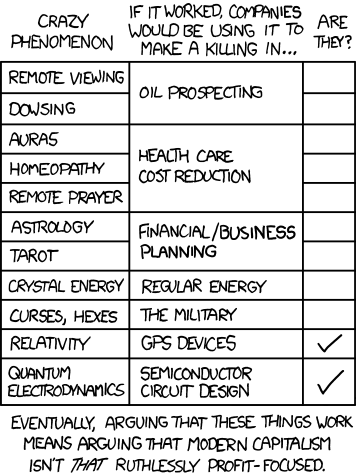
Good luck. P.S., if you are reading this and insisting that paranormal research has developed good, solid, theory, then I would point out that such theory regarding the sorts of things implied would allow for working applications of the concepts and powers studied. To that end, I will simply point you to this:

Friday, June 29, 2012

Undergrad Solves an Astro-Historical Mystery?

This is cool.  I was clued in to it by my friend Matt DeHayes, who posted a link on Facebook.

Researchers in Japan have found evidence in a spike in the amount of atmospheric Carbon-14 in AD 774 or 775 reflected in tree rings.  Typically, this is the result of a supernova expelling materials into the galaxy, eventually reaching earth.  However, nobody knew of any supernovae the ejecta of which would have reached Earth during that time frame, either through historic reports or astronomical data consistent with supernovae.

Then, some smart-ass undergrad at UC Santa Cruz (go Slugs!) by the name of Jonathon Allen got curious, and decided to do a Google search, finding a link to on-line transcripts of the Anglo-Saxon chronicles.  In it, he found reference to the appearance of a new "red cruciform" star near the horizon.  The placement and color suggest both a dust cloud obscuring some of the light and radiation, and that the "new star" would have been hidden by the sun after its initial appearance, thus explaining why there is little evidence of a supernova, and why the debris hasn't been observed by modern archaeologists.

Now, as always, it should be said that the observations of an 8th century chronicler, while valuable, were never intended to be used as astronomical data.  The chronicler wrote about what he saw, but it would, of course, be filtered through the political, religious, and social attitudes and requirements of the time.  So, there is a danger in taken what was written at face value, much less in concluding that this was definitely any one particular astronomical event.

Nonetheless, if further evidence comes to light, Allen may have set us on the path to solving a real, if small, historical and chemical mystery.  Stuff like this makes me happy.

Allen - you're making this archaeologist happy, and this UC Santa Cruz alumni proud.  Keep on doin' what you're doin'.

Monday, June 25, 2012

Primitive Science?

As a graduate student, I read numerous papers and articles which discussed the ability of hunter gatherers and early farmers to gather information and make sense of the resources available within their world.  Most of these provided useful information or perspectives, and I am glad to have read them.  However, nearly all of them made the same assertion - that the observations of these people are science. 

The basic assertion is that the people who are reliant on their environment to get by are extremely observant of it, and capable of making predictions regarding plants and animals, as they need to in order to survive.  This ability is typically referred to as "their science", asserting that it is the equal of "western" science. 

Now, don't misunderstand me.  If you spend much time studying hunter-gatherers and early farmers, you will be struck by just how well honed their observational skills are.  They tend to be keen observers of the behavior/tendencies of plants and animals, and they have to be in order to survive.  And while observation and prediction are vital parts of science, and in these peoples we can see how the raw materials for science are present in the human brain, science itself is another thing altogether.  Science makes use of observation, prediction, and the sharing of ideas amongst peers, and shares these traits with the people discussed in the documents to which I refer, but it also makes use of numerous methods intended to root out observational bias, including structured studies, peer review, regular discussion and review of findings, and vigorous debate among a huge audience regarding findings. If it lacks these elements, then it really isn't science.  But that doesn't make it somehow inferior, as it serves a somewhat different purpose and therefore should be expected to be different.

When part of a scientific exercise, observation of nature carries a certain amount of baggage and intention which is different from the baggage and intention of someone who is observing for the purposes of survival.  Hunter gatherers are generally not concerned with how their observations fit into broader theoretical models, such as evolution, any more than a field biologist is concerned with starving should they fail to catch their quarry.  A different set of needs, assumptions, and purpose are carried by the two different types of observers, and these influence what they observe and how they observe, making their activities different, even though they share many similarities and may be in many ways complimentary.

This assertion that the activities of hunter-gatherers and early farmers is a type of science (or, as it is often formulated, "their science") appears to come from a desire to make the people being studies or described seem more intelligent or noble than is often assumed, and to put their activities on intellectual par with "western" institutions.  This came, at least in part, in reaction to centuries of Europeans and their descendants viewing all non-Europeans as somehow primitive.  This assertion that the activities of hunters and gatherers was intended to show that these people are not primitives, but are, rather, quite sophisticated in their interactions with their environments.

The problem is that this is essentially the imposition of a "western" model onto people who live and think in very different ways.  To assert that their activities qualify as science is to impose a particular frame of reference onto them which they would not recognize as part of their activity, and is, ultimately, just as condescending as to insist that their activities are "primitive".  Just because observations are sophisticated, well-made, and intelligently considered, does not automatically make them science, as science requires another rather specific set of accompanying features.  Moreover, to refer to them as science is to ignore the context in which they occur, to ignore the way that the people engaged in the activities view them, and, in short, to be a poor anthropologist.  Moreover, the desire to "bring them up to our level", however well intentioned, is still steeped in the notion that we as western observers must ennoble the pursuits of other people in order to make them worthwhile (or at least show them to be worthwhile), which is about as condescending an attitude as one can take.

Hunter-gatherers are not generally engaged in science, not even "their science", and that's fine.  They are engaged in the necessary observation and predictive activities for their circumstances.  Recognizing that they are using well-honed intellectual abilities to pursue a goal is sufficient, and it shows them to be sophisticated, intelligent, and anything but primitive.  There is no need to impose an outside way of viewing the world onto them in order to accept that they are showing the very traits of intelligence that make us all human.

Friday, May 18, 2012

Professional Knowledge Vs. Sources

A few days ago, a friend of mine posted a link to a column on Cracked.com regarding the misconceptions that people have about U.S. history.  One of the issues discussed in the column was the tendency for most modern people to think of the pre-European contact native peoples of the Americas as both primitive and few in number.  In the process of discussing the matter, though, the columnist routinely drew from population figures that seemed, at the very least, to be a bit inflated.  This likely wasn't entirely the columnists fault - population estimates for prehistoric populations tend to vary widely depending on the methods (and sometimes motives) used by the person doing the estimates, and the author of the column (or, more likely, their source) appears to have used the highest population figures that they could find in order to bolster their arguments about the sophistication of Native American groups*.

So, I commented on the link, noting that the population sizes given seemed, to me, to be rather on the large size, and likely weren't very accurate.  My friend responded by asking me to cite sources.

This is, of course, a perfectly reasonable response.  Initially, my ego was a bit bruised (as I deal with analyzing these sorts of things for a living, I have grown accustomed to people just taking my word for things when, in fact, they should be asking more questions), but once I got over myself, I realized that this was a perfectly reasonable thing to ask.

The problem, however, is that there is no one good source to which I could direct my friend.

There are literally hundreds of published papers that provide prehistoric population estimates, usually providing detailed descriptions of the methodology used for making the estimates, and there are other sources that synthesize and summarize this information, though typically without providing a good description of the methods used to reach the various population estimates.  But there are no good resources that summarize the difficulties of estimating populations, nor the generally unreliable nature of most estimates.  This is something that is, quite simply, professional knowledge held by every archaeologist, and gleaned from spending several years in graduate school reading article after article, paper after paper, and book after book in which population estimates are made, and noting the various pros and cons of every method that you encounter. 

In the case of population estimates, they are always proxy measures, as prehistoric peoples, by the very nature of being prehistoric (that is, not leaving behind written records) didn't leave us with a census.  You can count burials in a cemetery, but this assumes that most of the people who died in an area were buried in its cemeteries (which is often not the case), that funerary customs and taphonomic conditions typically resulted in remains that will preserve archaeologically (often not the case), and that the burials provide a representative sample of the population (visit your local cemetery and note the volume of old vs. young people, as well as evidence of age associated with economic status, and you'll quickly see that this assumption usually doesn't hold).  So, once you do your count, you have to make a number of assumptions in order to come up with a population estimate.

Similarly, you could identify an artifact or feature (say, for example, house remains) and estimate population based on that.  The problem there, though, is that you have to make some assumptions regarding the number of people per artifact or feature, and these assumptions are often rather shaky.  Even when they're well founded, they still require an assumption that the ration of people artifact/feature remained stable across space and/or time, which is often not true. 

There are other methods, but what they all have in common is that we are trying to use some object or material that preserves archaeologically, and convert the number/volume into a population estimate.  And to do this, we have to make a number of assumptions (the precise assumptions made vary depending on the specific proxy measure), and this is rather problematic.  This is why archaeologists who are honest will both show their work and provide a range of possible population sizes (for example, John Johnson, in his doctoral dissertation examining prehistoric populations in the Santa Barbara Channel area, explained what his sources of data were, the shortcomings and benefits of each of those sources, and then provided a range of possible population sizes, rather than assert that a population of one particular size occupied the area - and then he followed that up by explaining that his estimates were the best that could be done with his data, but might well be wrong).

The problem, though, is that I have learned this by reading research papers, articles, and books, and from trying to apply some of these methods myself.  It's not something for which there is a ready-made source to which I can point people.  There was a decent article for the lay public published on Slate.com of all places that summarized some of these issues, but even it was rather simplistic in its descriptions, and exaggerated that guesswork side of things a bit. 

This got me thinking about the sheer volume of other issues that my colleagues and I are aware of simply by virtue of our training or repeated professional exposure, but for which we can not point people towards one, or even a few, good sources to summarize the issues.  These include issues ranging from the use of comparative ethnography in archaeological work; both the correct and invalid use of linguistic similarities in determining cultural affiliation; when it is valid to use old sources, and when it is a bad idea to do so; and when data patterns are due to human activity as opposed to natural movement and degradation of items over time within an archaeological site.

I don't know that there is a good way around this.  One could certainly write a source and try to get it published (the publication part is a bit problematic for a variety of reasons that I am going to get into at the moment), but it would, by definition, be outdated almost as soon as it appeared, and it would only cover one specific subject, while there remain many others uncovered.  On the other hand, I can routinely go into descriptions of these problems when I encounter them, but that may or may not satisfy individual people asking questions and I am only one person doing it.

So, it is something I will have to think about (and, if I am lucky, get some of my tenured academic colleagues to think about it - they get paid to write, whereas I do not).  I am not convinced that it is unsolvable as a problem, but it is so far unsolved.


*The irony of this is that the population size estimates are not the most important elements to establishing cultural sophistication, but for some reason we tend to equate statements such as "settlement X had a population bigger than London's" with an assertion that the settlement was, therefore, in some (usually unclear) way more complex than London, when, in fact, all that has been claimed is that it was larger.

Tuesday, May 8, 2012

So, You Want to be a Paranormal Researcher? Part 1

Every now and again I get an email at the ghost story blog from someone who wants to engage in "paranormal investigations" and wants some pointers.  So, I thought I'd write up what most of them have asked for as a blog post to which I can point them in the future.  I should also not ethat this was inspired, in part, by entries written by my friend Dave Hasbrouk


Now, let me make it clear to whom this entry is addressed - there is a sub-set of people who wish to engage in paranormal investigations who actually want to do it well and in a way that produces usable results.  These folks may or may not believe that they are going to find something, but they absolutely want to make sure that if they do, it will be something that could convince any fair-minded but discerning audience.  So, I am writing specifically for some of those people, not for the large number of people who simply engage in ghost hunting for fun (and activity with which I have no problem), or those who are convinced that there is some sort of big, bad "scientific establishment" out to "hide the truth" (a viewpoint based in delusion)

There is no shortage of how-to guides both in print and online, and pretty much every one of them is filled with nonsense.  I am, admittedly, not an expert on paranormal claims (I would point out that such a title is pretty much always self-appointed, though), but I am trained as a scientist, which means that I know how to look for and analyze data, and also that I know the potential that we all have to fool ourselves into thinking that we have proven something that we actually failed to prove (the entire scientific method is, in fact, built around trying to prevent a researcher from fooling themselves).  So, my how-to-guide isn't going to tell you what equipment to use, but it will tell you how to think about what you are doing so that, should you find something, it is likely to be something real and not simply a figment of your own imagination.

This is in two parts - Part 1 is about data gathering, and points out some of the basic issues involved in gathering your data.  Part 2 will be about the use of technology in gathering data.  Part 3 will be about theory - that is, the body of evidence and conclusions that form the basis of any solid research.  So, here we go with the data gathering:

Do your background research!

Typically, the paranormal investigators that I have encountered will assume that local rumors or folklore are accurate descriptions of historic events at an allegedly haunted location.  The problem is that they usually aren't.  It's pretty much a given that in looking into ghost stories for a location I will encounter someone who claims that a particular person once owned a property only to discover that the person is not in the chain of title for the property in question, or that a location housed a particular type of facility that even preliminary historic research demonstrates never existed on said property, or that there will be claims exaggerating real events (a good example is that hospitals with reputations for being haunted are often said to have had a number of deaths that, if accurate, would actually have killed more people than lived in the region that the hospital serviced).  That doesn't even get into the number of places that are allegedly built on Native American burial grounds, but are, in fact, quite a distance away from any type of archaeological site at all.

Here's the thing - records exist for all of these things.  The archaeological records are hard to access (there's alot of issues with sites being looted, so site records are usually considered confidential), but most of the other records can be gained through visiting the county assessor's office (to work out the historic ownership of a parcel) or even the local library (many libraries have local history sections that have both published works and primary sources for regional history).  If the property that you are looking into is particularly famous, you may even be able to find books written by qualified historians documenting the history of the place.  In addition, looking into more general local information will provide a good reality check - for example, if a hospital is reputed to have had 1,000 deaths per day due to tuberculosis, but is located in a county that at the time of the outbreak had a population of 10,000, you can be pretty sure that the death estimates are bullshit.

This background research is usually not easy - it takes time, effort, and a willingness to deal with basic bureaucracy, which can be trying.  However, if you have not done it, then you have no reason to assume that any of the information that you have gathered for a property is in any way accurate.  More importantly, if you have failed to do this research because it is hard and time consuming, then you have essentially demonstrated that you are more interested in the folklore than the fact, which is fine in of itself, but it does mean that you should call yourself a folklore collector and not a paranormal researcher, as you are failing to do even the most basic preliminary level of research research.

If nothing else, the fact that you can correctly point out where the folklore gets the facts wrong, and also give a well-documented accounting of what non-supernatural things are known to occur in a place, you will buy a good deal of credibility with whomever you are speaking.

The Problems of Eyewitness Testimony

Okay, you've done your background research, and now you're ready to collect data.  No problem, there's loads of people who have experienced strange things at the location of the investigation, so you're going to have no shortage of eyewitnesses to weirdness!  The skeptics will have to have their eyes opened when they can't explain what people have seen, heard, and experienced here.  AmIright, or what?

Well, no, not really.

See, most data regarding supernatural events comes from eyewitness testimony, which is notoriously unreliable. In fact, it is increasingly becoming a concern when used as evidence in trials, see here, here, here, and here.  In fact, the Supreme Court of the State of New Jersey recently made a ruling calling out for new rules to be used in eyewitness testimony because of the problems with eyewitness unreliability.

There's a fair chance that you are reading this and wondering just what the hell rulings on criminal law have to do with paranormal investigations.  It's relevant because the issues with eyewitness testimony in a criminal trial also apply to every other form of eyewitness testimony.  And understand, these criminal cases involve trained observers such as police detectives, as well as people who have often witnessed huge important events (and are therefore often certain that they have a vivid memory of said event), and they are testifying in cases that at the very least involve property and are often literal matters of life and death.  If eyewitness testimony is problematic in criminal trials, it's fair to say that it is at least as problematic in a paranormal investigation.

Eyewitness testimony has its place, but from a scientific standpoint it is a weak form of evidence, and should never be taken at face value without other evidence to back it up.  There are a few reasons for this, and you need to understand them if you are going to actually use eyewitness testimony (including your own) as evidence for a claim.  Basically, it boils down to the limited nature of human perception.


Our eyes don't see all of our field of vision at any one point in time.  They are constantly moving, scanning, and only see a small portion of our field of vision at any given instant.  Our brain compensates by filling in the rest of the picture via our memory of what our eyes saw the last time we looked in a direction, as well as our general memory to fill in gaps.  As a result, it is common for people to mistake one type of object for another if it is hovering just at the edge of our field of vision - our brain fills in the details and tells us that one thing is in the area when something else is (edited 7-17-12: the webcomic XKCD has a great illustration of this here).

A case in point - a couple of years ago, I was standing in the post office, when a woman walked in behind me.  I saw her just out of the corner of my eye, and she bore a striking resemblance to the character of Veronica Palmer from the show Better off Ted, complete with grey business suit.  When I turned around again, I realized that, while the woman was tall, thin, and blonde, she otherwise bore no resemblance to the character, and her clothing consisted of a white shirt worn under a black apron from the bakery across the street.  My eyes had caught just enough of her to mark a few elements of size and color, but not enough to accurately account for her appearance, and so my brain filled int he rest with an image from memory that had some similarities.  When I turned around and was able to actually see her, she bore little resemblance to what I originally thought that I had seen.

This is very common - all of us do it, it's how our vision works.  And when we're tired, or stressed, or pre-occupied, or in low-light conditions, our eyes don't scan as well, and our brain has to go into overtime filling in gaps that our eyes are missing.  It's the reason why so many ghost witnesses describe seeing things "just at the edge of my vision."  And remember that our brain seeks patterns from our memories, so if you are constantly reading paranormal books, watching horror movies, etc., then the things that your brain has to draw from include those things as well - in other words, your' vision of an apparition might just be your brain trying to compensate for tired eyes. And, weirdly, these false images actually mean that your brain is working correctly, even when your eyes might not be.

In other words, many a spooky encounter might be due to the fact that our eyes suck.

There's another problem with perception that comes into play, as well.  This is called pareidolia, the tendency for our brains to try to force a recognizable pattern onto randomness.  It's the reason why we often perceive faces in the leaves of shrubbery, animals in the shapes of clouds, and so on.  It doesn't just work in our vision, though.  People tend to hear voices or music in what is clearly just random noise (for some cool examples, go here), and may even feel sensations on their skin that they misinterpret due to unfamiliarity. 

Okay, though, you have someone telling you that they saw something head-on, that it wasn't at the corner of their eyes, it was very detailed (ruling out simple pareidolia), that they were well-rested and out in daylight, and it was there long enough that it couldn't have simply have been their brain filling in details until their eyes could catch up.   What's more, there's no reason for this person to lie.  That would be proof, right!

Well, this is definitely better evidence than is usually presented to support claims of hauntings.  However, there is another problem: human memory.

People tend to think of memory as being like a computer's hard drive - data is stored, and then recalled as needed.  This isn't how it actually works, though.  Our memories are malleable, always changing, and changing due to a number of factors.  To make matters worse, whenever we recall a memory, we don't simply re-play it, we re-write it, taking things out and adding things in as befits the narrative forming in our mind at that time.  This means that our especially vivid, often recalled memories (where you were on 9/11, the first kiss with your spouse,  the death of a pet, your favorite childhood outing) are far more likely to be flat-out wrong than the memories that we recall less often.  And, to make matters worse, we can form unshakable, but patently false, memories due to suggestion.  And this is important:  this is true of normal, perfectly sane and healthy people.  This is not unique to people with psychiatric disorders, it is true of every human on the planet. 

To make matters even worse for eyewitness testimony, these tendencies are very prone to impacts from our direct experiences and social pressures.  This is the reason why someone who doesn't take ghosts seriously is very unlikely to encounter one, while people who hang out with believers are very likely to experience one.  Our brains are processing information based in part on the external world, and in part on our own internal workings and the social pressures working on us.

So, a perfectly sane, honest person can have fabricated memories of events based on their own psychological pressures as well as on the faultiness of human perception. 

By all means, gather eyewitness accounts.  These can be valuable when you are trying to figure things out.  But be aware that even the best eyewitness account is poor data from a scientific standard because of all of the issues discussed above.


Third Men, Emotion, and Perception

Related to the above-discussed issues with human perceptions, you also have a few other psychological factors at work that can be problematic to someone wanting to research a haunting.  Let's start with reported emotions.

When you read the accounts of haunted places, a very common thing that ersatz researchers will report is feelings of dread, fear, or startlement that they encountered when entering an allegedly haunted location.  Many people, called themselves "sensitives" will act as if their experience of these feelings is somehow objective proof of something spooky.

The problem is that we tend to ignore what our emotions actually our.  Our emotions are not the results of us somehow receiving "vibes" through the air, or being hit by weird energies (indeed, when someone talks about "energies" or "vibrations", you can be pretty sure that they don't know what they are talking about).  Our emotions are evolved responses to help us survive, and as such they have environmental triggers that make us feel certain things when confronted with particular stimuli.  So, entering a dark place where you expect to encounter something scary and weird?  That's going to make you experience feelings of dread, and it will make you easily startled, even jumping at things that are products of your own eyes and brain (as described above).  Feeling dread, fear, feeling as if we are being watched, etc. in the dark or when entering a place where we anticipate trouble is evidence of our evolutionary history amongst predators and other (sometimes violent) hominids, not of us being "tuned in" to something paranormal.  These types of reactions are normal, and have been studied by neurologists and psychologists, and so appealing to them as evidence of the paranormal indicates that one hasn't done their necessary research into perception, not that one has encountered a spirit.

To make matters even weirder, we have psychological effects such as the Third Man Factor (a term coined by author John G. Geiger), where a person under extreme duress (you know, like being extremely frightened while hunting for ghosts) will experience the presence of an incorporeal being who encourages them.  This appears to be another evolutionary adaptation in which our brain is literally telling itself to go on.

Now, I am going out on an interpretive limb here, but I would make an observation: most of our brain's survival techniques can get triggered by weird things, and are often triggered differently in different people.  I suspect, though I will be the first to admit that I have no evidence of this, that for some people, the Third Man might be triggered with minimal duress, or maybe with none at all.  This would explain why many otherwise perfectly normal people experience "presences" under some circumstances.  Given that many people have even inadvertently trained themselves to access some of their brains funkier functions, it seems reasonable to think that many people may have likewise trained themselves to experience a Third Man under particular conditions, possibly explaining why some people seem to routinely be contacted by spirits - it may literally be a normal part of their brain's functions being triggered under odd conditions.

Again, this doesn't necessarily mean that you should ignore emotional/internal reactions to places.  It does, however, mean that you shouldn't assume that you feeling something or sensing a presence means that it is really there, rather than something internal to you.


Does Your Data Mean Anything?

It is extremely common for paranormal researchers to gather data - whether it be their impressions, or information from equipments, or the claims of psychics - without any regard for what it actually means.   Here's a primo example:  if you hang out with ghost hunters, it won't be long before someone declares that a battery being drained quickly is evidence of a ghostly presence.  How do they know?  Well, everyone knows that the presence of ghost drains batteries, therefore a quickly drained battery = a ghost is about.

the problem is that nobody has ever established that this is actually the case.  It is, as far as I can tell, just a bit of lore that gets passed along from one ghost hunter to another.  Account is never made for the types of the batteries, the failure rates of the batteries, how old the batteries were before they were put into the device in which they are being used, whether or not their was some sort of equipment malfunction that could train the batteries*, etc.  All of these things are relevant to the use-life of a battery, but none ever seem to be accounted for (or they are hand-waived with a statement like "they were new batteries" - but, you know, I have had crappy new batteries that died quickly).  In other words, the data is collected ("battery drained") without any real reflection on whether or not this bit of data actually means anything at all.

Likewise, if you gather data based on what you see or feel, then you should also keep account of the various different factors that may influence what you perceive.  Hell, in field archaeology I have to keep track of this sort of thing (noting levels of fatigue, weather conditions, lighting, etc. in my notes), and we are nowhere near as subjective in our observations as ghost hunters are.

Add to this that there is often no attempt at bridging arguments made between data collection and the drawing of conclusions.  Basically, if you say "we saw strange lights, therefore: GHOSTS!"  you are being a fool.  Why would ghosts cause the lights?  Is there no other phenomenon that could cause them?  Even if you have ruled out all other phenomena that you can think of, that doesn't necessarily mean that it is ghost, it may simply be a phenomenon that you haven't considered. 

What I am saying is this: not all data is meaningful.  Some of it is just due to flukes (you got bad batteries, bro!), some of it is only relevant in context (what were the lighting conditions when you saw this shadow person?), and all of it has to be interpreted to be meaningful.  I'll go into this in Part 3, but you need to keep all of this in mind when you attempt to make sense of your data.


So, in Conclusion...

Many years back, I read an article in which a parapsychologist was being interviewed.  He said that he found it frustrating that scientists weren't taking his work seriously when he was doing "solid, good science."  The problem is that, as he described his work, he never did his background research (relying instead on local folklore), he always took the perceptions of himself and his team at face value without considering the limits and problems of human perception,  and he routinely gathered emotional and psychological impressions of places as if they were solid, reliable data.

In other words, he was routinely failing to observe even the most basic rules of data gathering: identify and account for potential biases; do not become overly-reliant on biased data.

He was not doing good science.  He really wasn't even doing science at all, contrary to his claim. 

If you are serious about investigating paranormal phenomenon, then don't make the same mistakes that every (and I do mean, pretty much without exception, EVERY) self-proclaimed parapsychologist makes.  Instead, learn something about the place, be aware of the limitations of yourself and your colleagues, and approach your work with the mind-set that you can be fooled, sometimes even by your own senses, and that you have to find ways to account for that.

Next time I'll get into the issue of using equipment in this sort of work, and how a serious paranormal researcher can save themselves some money.


*In high school I took classes on basic electrical work, and one of the fun pranks we would play was find small ways to tweak someone's work so that it would drain their batteries, but appear to function normally.  In other word,s your video camera may seem to be working without a hitch, but could still have a problem (sometimes an intermittent problem) causing battery drain. 

Sunday, September 25, 2011

Cern, Neutrinos, and Good Science

So, you may have heard that scientists at CERN found Nuetrinos moving faster than the speed of light, something that should be impossible according to Einstein's Theory of Relativity.  The thing is, it's not certain that they actually observed that, and for all the time that the media spends talking up the discovery, the researchers have been much less certain.  They have stated that their work appears to show that the neutrinos can move faster than the speed of light, but they have released their data and have requested that other scientists confirm their results and try to replicate their experiments to make sure.  While they did annoucne this to the press, it was after careful internal review of their data, and the simultaneously provided their data to the research community at large rather than claiming to have made a massive discovery and hiding or falsifying the data.

This is how good science works.  Contrast this with the way that various other groups do it: creationists (both of the young-Earth and the Intelligent Design camps), global warming deniers, vaccine deniers, cold fusion enthusiasts, etc. etc.  They find a study that seems to vindicate their position, don't look too closely at the study itself or the reasons why it was put together (media attention?  money to be made?), declare that it is the "final word" on the subject (even when it clearly is not - Andrew Wakefield supporters anyone?), and then refuse to engage with critics in any meaningful way.  How many times has someone announced that their idea will replace dominant scientific thought and overthrow "the dominant paradigm"...only to fade into the background. 

By contrast, these scientists (whose work actually could overthrow - or at least greatly change - the dominant models) are requesting that others check their work and make sure that it is correct.  They are well aware that they may have made a mistake, and they want someone to find it as they have failed to do so.  They are, in short, well aware of their responsibilities, and are looking to make sure that they are not fooling themselves.

That is good science.

Friday, September 23, 2011

Racial Realism?

I was recently introduced to a new, and rather disturbing, term - "Race Realists" The concept of human race was once considered something of a fixed and real biological thing - with three major divisions (representing peoples from Europe, Asia, and Africa), and then many sub-divisions among these.

Now, most scientists hold that it is more of a cultural construction - that is, the way that people are grouped into races (based on skin color, hair type, facial morphology, etc.) is due to flukes of history rather than significant or meaningful biological differences, and the way in which we divide people up into racial groups is based more on cultural norms and ideals than on any actual biological information or model. The traits used to divide people into racial categories are often essentially arbitrary and based on what were the common traits in a given region as of a few centuries ago. Those who argue that there is a real biological phenomenon at work still tend to point out that the variation between races tends to be A) a result of historic geography (and therefore fluid and changing) and B) have as an end-result a tendency to create what could be called statistical "clumps" of traits - traits are more common in some groups than in others, but can be expressed in groups not generally associated with those traits.

The "Race Realists" (I refuse to use that term without scare quotes, as there is nothing realistic about these people), by contrast, believe that race is both a real biological phenomenon (that is, they tend to deny that there is social construction at work here) and that it is a reliable predictor of various traits (though they tend to focus on intelligence). The information that the "Race Realists" tend to cite is a handful of studies that show IQ differences between different ethnic groups, and a mish-mash of biological and anthropological studies on racial differences as well as polls showing the attitudes of anthropologists and biologists regarding the concept of race as a biological reality. Oh, and it's not uncommon for them to simply lie and claim that the studies and polls reach conclusions that they don't actually reach (for a good description of the problems with one particular "Race Realists" views, go here...and as the keeper of that blog, a fellow anthropologist, points out, the technical term for what the "Race Realists" are doing is biological reductionism).

There are a number of problems with the concept of race as a biological fact, and most of these are addressed at the blog linked to above, but I want to talk about a few specific problems here, as well as the apparent reason why people adopt the "racial realist" stance. The basic problem with the "Race Realist" stance is that ethnicity is, by its very nature, fluid. To explain why, though, requires a bit of basic biological background.

When a group of people splinters off from a larger population and leaves to occupy a new area, they carry with them a sub-set of the genes of the larger population, and (assuming that they are relatively isolated from the larger population) their descendants will resemble the members of the splinter population more than the larger population that spawned the splinter group. This is the Founder's Effect. So, if a group of colonists from the Red-Headed League leaves Ghoofiland, then the descendants of these colonists will have a larger number of redheads amongst them than the population of Ghoofiland did - the descendants of the original colonists will not be entirely redheads, as they will have carried the genes for other hair colors as well, but there sure will be a butt-load more redheads among the colonists' descendants than among the people of Ghoofiland.

Another matter that comes into play is genetic drift. This is the tendency for certain traits to become more or less common within a population due to random sampling. So, let's say that brown eyes start to become more common among the colonists, after a few generations there is a colony that has a larger number of brown-eyed redheads than one would expect in Ghoofiland.

Then, of course, there's selection. Perhaps the colonists have occupied a location that is rife with insects that carry a particular disease, let's call it Rubenitis, and say that it results in a chronic condition that involves lethargy and speech impairments. Some of the colonists carry a gene that gives them some resistance to Rubenitis, allowing them to go about their daily business while some of their fellows are having to routinely lay in bed while having a hard time conveying information to those around them. The ones who don't have the chronic condition will have more time and luck finding mates, and therefore their genes will be spread at a faster rate than those without the resistance. So, even elements that aren't directly linked to disease resistance (say, skin tone - many of those with the resistance have a slightly bluish tinge to their skin) will increase in frequency.

After several generations, the colonists begin to look a bit different from the people of Ghoofiland. Given a long enough amount of time, they will look and behave (remember, culture is also changing in both populations) differently enough that they will be considered (and likely come to consider themselves) a completely different ethnicity, or "race" to use the term in the way that the "Race Realists" tend to. Are there biological differences between the groups? Yes, there are cosmetic differences such as frequencies in hair color, eye color, and skin tone, as well as functional differences such as frequencies in resistance to disease...but these are differences in the frequency of genes and in phenotypes (the observable expressions of those genes - two organisms with the same set of genes may have different behaviors or traits if the environment forces different gene expression), each population still has most of the same genetic material (allowing that some new genes may have occurred due to mutations in either population), just in different frequencies, and each lives in different environments resulting in the shared genes potentially being expressed in different ways.

So, we now have two different races of people. What happens when they meet, say because technological change allows rapid transportation between their different homelands? Well, if history is any guide, they may or may not come into conflict, but they will definitely interbreed. In interbreeding, they will change the gene frequencies (and hence appearance) of both populations. The interbreeding may be slow, but over time it will change both populations significantly. If there are social taboos against interbreeding, this will slow it further, but if history is any guide, it will not stop it.

When we look at the modern world, we see several populations that sprang from the same stock population in Africa, and eventually went on to populate the rest of the continents (okay, Antarctica excepted). Some of these populations are more closely related to each other than others, but we ultimately have the same basic process as described above, just played out ona grand scale of both geography and time. However, all human populations are still so similar to each other that we can, and do, have viable children with each other, and we are, slowly but surely, changing the gene frequencies in every part of the world. Racial categories that once made perfect sense due to the relative isolation of populations are now thought of as nationalities, because the populations are no longer isolated and are intermixed. While there are still likely to be definite phenological differences between someone plucked out of the middle of Europe and someone plucked out of the middle of Africa, the populations are converging at a slow but definite rate. That's not to say that there will, someday, be only one ethnicity, likely something will occur that will restore isolation (wars, societal collapse, etc.), but the populations that are isolated this time will be different than those from the last time, with different biological and cultural traits. In other words, even if they call themselves the same things, there will be different races from the standpoint of genetic and phenotypic variation.

And this is nothing new, one need only read some of the old Roman or Greek histories to see that there were once distinct populations throughout the Mediterannean that have since merged with other populations, creating new ethnicities. Race/ethnicity have always been fluid. Okay, so, even if there are biological races (which is debatable, as there is no clear way that one would decide when a person was a member of one race and not another, as we are talking about gene frequencies not markers of certainty - the very concept of "biological race" is murky at best), that doesn't mean that these represent any sort of distribution of traits such as intelligence.

That being said, is it possible that variations in genetic and phenotypic frequencies may also result in variations in intelligence? Maybe, but there are problems with that assertion. The definition of intelligence is a slippery term. We typically use it to mean the ability to aggregate data and engage in abstract thought in order to plan, process, and interact with the world. Seems straightforward, right? Humans are clearly more intelligent than hamsters. Humans are clearly more intelligent than dogs. But when we start comparing humans to each other, it gets muddy. Is a master chess player - clearly someone possessing a skill set requiring great intelligence as applied to mastering a rule-set and thinking ahead - more intelligent than a well-connected socialite - someone who has had to master a skill set requiring planning and thinking ahead in interacting with other people? To answer that question, we would have to decide that one set of skills requires a greater degree or type of intelligence than the other, which may not be the case. The chess player is likely better at dealing with systems and rules, but the socialite has to be able to engage in situations which are much less predictable and prone to sudden change. Both are displaying a high degree of intelligence, but applied in different ways, and possibly even different types of intelligence. So, is one more intelligent than the other? Hard to say, and the question might actually be completely meaningless when applied in this way. What's more, there is evidence that intelligence, in this sense, is somewhat malleable, and that someone can actually improve it by their actions and education. Also, there is strong evidence that intelligence is tied to issues such as nutrition, conditions during pregnancy, and early childhood, all of which are highly dependent on things not tied in to genes but to physical and social environment. So, your ethnicity may have much less to do with your intellectual capacities than do your parents level of affluence or poverty.

Most of the "Race Realists" like to cite studies showing IQ differences amongst ethnic groups. On the surface, the use of IQ seems ideal, as it measures a few specific skills and provides an overall quotient for the person taking the test. There are a few very serious problems, however. The first is that the simple act of taking a test - while most of us who attended schools in the U.S. and Europe don't think of it as such, test taking itself is a skill, and people can be trained to perform better on tests without actually knowing more about the subject of the test. So, if you compare a group of people who have attended affluent suburban schools with regular testing to people who have attended poorer inner-city schools with less regular or rigorous testing, you should expect the people from the suburbs to perform better not because they are necessarily more intelligent, but because they are more accustomed to (and trained for) taking tests.

Another problem is that the tasks and the questions within an IQ test are not devoid of their own cultural context - they reflect, from the actual tasks or questions chosen to the way that they are worded, the background of the people making the test (despite the best efforts of these individuals to eliminate this), and that means that the closer you are in social class and culture to the makers of the test, the less time and energy you are likely to spend trying to decipher what a question means are how a task should be performed. And when you start looking into studies of IQ across ethnicities, these types of issues tend to show up time and again, meaning that the results of the studies, while interesting and potentially of value, should not necessarily be taken to reflect a biological rather than social reality.

So, the case for biological race is a shaky one, and the claims that there are distinct intelligence difference between races even more so. So, why are the "Race Realists" even making these claims?

Well, many (probably most) of them are, of course, just good old-fashioned racists. They have heard that there is a new set of arguments that they can use to try to justify their existing bigotries, so they are jumping on them. But it's just a post-hoc rationalization for their old prejudices.

Others, though, are a bit more complicated. For basic historical reasons, there are a disproportionate number of people of African and Native American descent within the U.S. and Europe who are impoverished. There are many, admittedly often expensive, social programs aimed at trying to change this. If an argument can be made that the poor can not be helped, then that undercuts the programs and provides a rationalization for removing them altogether. Now, it should be said that the majority of people who oppose social programs do not engage in this sort of racist thinking - their oppositions are on philosophical or political grounds, and the ethnic make-up of the people affected by these programs doesn't enter into the matter for them (or if it does, it does so in a much more complex way than is often portrayed). However, there is a sub-set of people who are opposed to social programs who see using a notion of biological racial differences as a way of arguing against the usefulness of social programs, and therefore for eliminating the program - whether or not the impulse for grasping the argument is racist, the outcome most certainly is.

Now, many "Race Realists" would respond to what is written here by saying that, because of historical rather than scientific reasons, legitimate research into racial differences tends to be stifled and little reported. They might have a point, but their response is to exaggerate, misrepresent, and often lie about both the outcomes and the quality of the research that is available. You don't fill a gap in knowledge with ignorance and expect it to be respected.

Wednesday, August 3, 2011

Osteology Software Buying Blues

When I was an undergraduate, I took a class on human skeletal biology. The class was difficult*, and I was always on the lookout for anything that might help me out. To that end, one day, I headed to the local Software Etc. store**, thinking that, seeing as they were in a college town and did stock some educational software, they might have something that would be helpful.

I walked in, approached the counter, and explained to the guy standing there (the employee, not some random customer trying to buy his software) that I was an anthropology student, and was looking for educational software that covered human anatomy in general, and bone in particular.

the guy behind the counter - I am tempted to say "kid behind the counter" but he wouldn't have been much younger than me back then - snorted, and said "they weren't human."

A bit confused by his answer, I said something extraordinarily witty, like "huh?"

In about as condescending a tone as the little twit could muster he said "You said your an anthropology student. You don't study humans. You study those monkey things. Even if we have the software, it wouldn't help you."

I attempted to explain that anthropology was the study of humans - modern and otherwise - in general, and yes, I was looking for software on the anatomy of modern humans. His response? "No, you're looking at like Lucy and stuff.

I was flummoxed. On the one hand, I was trying to spend money in this guy's store, and his attitude was making it difficult for me to justify doing so, much less actually do it. On the other hand, I was an anthropology student, he had clearly never taken an anthropology class and didn't know anything about it, and I was clear in what I was looking for and that it would cover modern humans, and he was still insisting that somehow I was the one that didn't know what I was talking about.

I finally said "Look, I know what I am looking for, you obviously don't. I am studying the bones of modern humans, and I am looking for software that can help me study."

He snorted again, gave me a disdainful look, and said "Lucy wasn't a human."

I stared at him with irritation and said "depends on what you mean by human, but that's beside the point, because I am studying the bones of people walking around in the world today."

He rolled his eyes, gestured towards a rack of programs and said "there might be something over there."

I looked over, and then turned and walked out.

To this day, some sixteen years later, I still find myself wondering about why this guy had such an attitude. Was he simply one of those arrogantly ignorant fucks who is sure that he is the master of all sorts of specialized knowledge when he actually knows very little about, well, anything? Was he a creationist who was upset with the findings of paleoanthropologists and therefore wanted to show up one of them only showing his own ignorance in the process? Was he just a disagreeable ass who was unwilling to admit that his initial assumptions were wrong even as it became increasingly obvious that they were?

I don't know. What I do know is that that was the last time I ever walked into a Software Etc.


*Though in the end, I received either an A or B, I forget which.

**This was back when Software Etc., which has since merged with another store and become Gamestop, stocked a wide range of software, not just games. As odd as looking for something this specialized there might sound, they did sometimes have such specialized programs.

Thursday, June 30, 2011

Archaeologists Don't Dig Up Dinosaurs...Except When We Do

Normally, when somebody asks me if I dig up dinosaurs, I become annoyed. I have to explain that archaeologists study the remains of past human activity, and that prehistoric animals (unless hunted and butchered by humans) aren't really my bailywick.

Then this week happened.

One of my company's owners realized that if he has us out there looking at the ground anyway, and we're already trained to identify bone and teeth, we might as well also be looking for fossils as well. This provides better protection for paleontological resources (archaeologists get around far more than paleontologists, as the laws requiring our presence tend to be a mite bit more strict and expansive). However, while there is a bit of overlap in the sorts of things that we look for (some of the early human sites in the Americas contain Pleistocene animal bones that paleontologists are interested in), there is also quite a bit of difference. So, having archaeologists qualified to identify and handle paleontological resources requires that the archaeologists actually, you know, get qualified to do so. To that end, my coworkers and I spent the last few days at a small paleontological museum being trained to identify and recover fossils.

Now, we were not being trained to be actual paleontologists. We are archaeologists who now have enough knowledge of paleontology to know how to protect fossils that we find and when we need to contact the real paleontologists to deal with things. Oh, and we will only do this work under the supervision of a real paleontologist, so it'll be difficult for us to fuck shit up too badly.

I don't know if it's just a reaction to HAZWOPER training, or if it was the content of these classes in and of itself, but the paleontology class has been a hell of alot of fun. We went from covering the laws and implementing regulations that provide what protection there is for fossils, to covering the basic geology that we need in order to make an assessment of the paleontological sensitivity of an area, to discussions of the types of fossils that we are likely to encounter in different parts of California. The next day we gained some hands-on experience preparing a fossil for collection*, and then preparing them for identification in the lab**.

So, basically, I got paid to hang out with coworkers, learn some stuff, and handle fossils. It was fun.

But I guess this means I can't be as pissy next time someone asks me if I dig up dinosaur bones. Harumph.


* When identified, if the fossil is both small and in good shape, it can simply be picked up. If it is large and/or in poor shape, then you engage in a process called "jacketing." In this process, you dig around the fossil in a process known as pedasteling (we use the same approach with certain types of artifacts in archaeology). Once the fossil is appropriately pedestaled, you place wet tissue (what you and I know as toilet paper) over the fossil, and then cover this with plaster-soaked burlap in order to provide a protective plaster-and-tissue cover. You then use your trowel to cut the pedestal off, taking as much dirt as is practical with you to further protect the fossil, and cover the underside in tissue and plaster. This produces a large plaster package that you can then take to the lab and be secure in your knowledge that the fossil is in good shape. Of course, before you even begin this process, you will take GPS coordinates and take notes on the nature of the fossil, location, orientation (on it's side, standing up, pointing north, etc.), and also note the local geology.

** This is where you use a dental pick and paintbrush to carefully remove the dirt surrounding the fossil without damaging it. It was fun to do, but I imagine would get tedious if it was what I normally did for a living.

Tuesday, June 14, 2011

The Up-Side of Criticism

I wrote a few months back about a site that may be the oldest discovered in North America. Of course, scrutiny of the report, of the methods applied to determine the age of the site, and of the meaning of the results has begun. This is as it should be. I am pursuaded by the results, but there nonetheless remains the possibility that the site is not as old as is thought. The published paper is coming in for criticism, and if it withstands the criticism, or if the criticism forces out more information regarding the site that supports the claim of old age, then it will vindicate the researchers claiming that it is a pre-Clovis site. If it doesn't withstand the criticism, then we may avoid a research dead-end without wasting too much time.

And this is how honest research works. The scientists - be they archaeologists, biologists, physicists, or any other - produce work, which is submitted to their peers for criticism via publication. Sometimes the criticism can be heated, and scientists being human, it can often become personal and even vicious. But it is ultimately constructive, it helps to weed out bad ideas and dead ends, while promoting strong ideas and helping to ensure good data. There are often blips where bad ideas or data continue to be propagated for a time due to the, very human tendency to get attached to ideas, but in the end, these get phased out in favor of better information.

This is probably the principal difference between science and pseudo-science. In pseudo-science there is a tendency to hold on to ideas despite evidence, and there is an over-riding tendency to view any criticism as an attack or an attempt to crush a novel idea under dogma. The problem is, of course, that it becomes impossible to actually forward a research agenda based on anything even vaguely like reality. If criticism is rejected out of hand not because of its validity but because it disproves a pet hypothesis, then no research that comes out of those who reject the criticism is likely to be valid - they may occasionally reach correct conclusions, but it is as likely to be due to accident as to actual insight or information.

So, when I read accounts of various pseudo-scientific individuals complaining that "the Establishment" won't accept their claims, it always rings hollow. whether it's fantasists complaining about history and archaeology, crackpots complaining about physicists, creationists complaining about biologists, or naturopaths complaining about medical science. "The Establishment" doesn't easily accept the claims of "the Establishment." Everybody gets scrutinized, it's not dogma pushing brilliant conclusions away, it's researchers keep themselves and others honest.

Friday, June 3, 2011

There's No Money In It?

A few weeks back, several friends of mine sent me links to an article that falsely claimed that Canadian researchers had developed a cheap and effective cure for cancer, and that it was simply not being developed because "there's no money in it." Because, you know, cancer researchers are only in it for the money, there's never been a single one engaged in the work for reasons of altruism, or desire for an intellectual challenge, or even simple curiosity. Nope, never happens.

That got me thinking, though, about the popular narratives in our society regarding research and how they get applied to different people and institutions. The "THEY don't want you to know THIS because THEY will lose money!" notion is very popular, but gets applied unevenly. It is usually applied to the medical industry, but pretty much never applied to the alt-med industry, even though your local homeopaths, naturopaths, acupuncturists, and reiki providers all make money off of what they do, and would be just as put out financially were you to be cured of your ailments as your local doctor and pharmacy. It's common for many of the alt-med supporters to say that their favored practitioners favor preventing illness, and therefore don't stand to lose money if you are cured of illness...but, well, so do both doctors and the medical insurance companies, two of the three big players in the medical industry.

Doctors favor it because, if they can get you to do preventative care, they can lighten their work load, still make money (preventative care still requires doctor visits), and potentially lower their malpractice risk. Moreover, doctors associated with hospitals spend a large amount of time treating people who are uninsured and impoverished, and therefore will actually result in their institutions losing money, and getting people to engage in preventative care reduces these losses. And that's without getting into the fact that people generally don't become doctors to become wealthy - if one wishes to make money, pursuing an MBA is both less time consuming and has a much higher rate of reward on the other end. Most people become doctors because they are either interested in medicine from an intellectual standpoint, or they want to help people. In over three decades, I have yet to visit a doctor and have them not speak with me about nutrition, exercise, healthy sleeping habits, and other issues aimed at reducing the risk of disease.

And insurance companies lose money when you get sick. Every time you require a medication or treatment, the insurance company has to pay out, meaning that it is in the insurance companies' best interests for you to remain healthy. In fact, a common feature of insurance policies is that the company will pay a larger portion of preventative care visits than treatment visits, specifically because this is a good strategy to make money.

Really, the only part of the medical industry that benefits from people becoming or remaining sick are the pharmaceutical manufacturers. And even there, it's not quite that simple. Pathogens, including bacteria and viruses, mutate and require new treatments. Old treatments can be improved upon, and as some diseases are made less urgent with treatment, resources are opened up to deal with others. In other words, there's not precisely a shortage of diseases needing medications. In fact, one of the main legitimate criticisms of pharmaceutical companies is that they are more interested in developing medications for the treatment of mild problems for wealthy people than serious problems for poor people.

All three of these groups - the doctors, the drug manufacturers, and the insurance companies - can do, and have done, some shady things. I am not trying to claim otherwise. However, the notion that something such as a cure for cancer would be ignored simply because it doesn't seem likely to make gobs of cash is, frankly, absurd. If nobody else did, the insurance companies would push this to the forefront because they would make money from a cheap, effective cure for cancer.

By contrast, most alt-med purveyors do make money from not providing information about cures for diseases. There have been a large number of studies on reiki, acupuncture, homeopathy, etc., and while there is some small evidence of some efficacy for certain types of pain reduction from acupuncture, the others routinely fail even the most basic of blinded trials. Chiropractic shows some efficacy for lower back pain, but most chiropractors offer basic physical therapy (a conventional and non-chiropractic treatment) in addition to chiropractic treatments, but don't inform their patients of the difference. And if one looks into herbal therapies, there is an astounding mish-mash of stuff that does work, stuff that doesn't work, stuff that might work, and stuff that's dangerous to the patient, all of which gets pushed with equal fervor without regards to efficacy.

In many cases, people are encouraged to use these types of treatments for conditions that are, in fact, treatable or even curable by standard medical treatments, but not cured, or even made worse, by the alt-med treatments (such as infections, spinal problems, tendonitis, etc.).

So, while I can understand the suspicion that many people have of the medical industry, a suspicion that is sometimes earned, the same suspicion should also be held towards the alt-med industry, which also makes huge amounts of money, which also (just like the medical industry) has political lobbyists trying to push laws in favor of the alt-med industry, and which tends to be happy to push untested, disproven, and even dangerous treatments onto it's patients.

Incidentally, while I was writing this, I checked my email, and saw the following advertisement in the side-bar:


I find much hilarity in the notion that there is a shadowy cabal of dermatologists secretly plotting what skin care secrets are released to the public, and which are kept hidden away, I am assuming in a dusty tome bound in leather made from human skin.

Tuesday, May 17, 2011

The Big Pharma Boogeyman

Yesterday I saw an article claiming that Canadian researchers had found a cure for cancer (I will post this link to an article in the New Scientist that actually explains what really happened), and the article implied (without outright stating) that this information was being either ignored or suppressed. In short order, I saw two responses by researchers (one of whom I know personally, the other of whom is a friend of one of my closest friends) who pointed out that the author of the article completely and utterly misunderstood the research, and comitted such rookie errors as claiming that normal metabolic processes are freakish and unhealthy. The actual research found that a particular generic drug did show positive effects when used against a particular form of brain cancer. Cancers are all different, and even this drug did not cure this particular form of cancer (let alone all cancers) so much as show effectiveness at either stopping progression or reducing the tumors. Also, the study was small, and therefore not statistically significant, but it wasn't intended to be, it was intended to test whether or not the underlying concept was valid, which it appears to be, in order to pave the way for a larger, more robust study (this is how good science works, small studies don't give the final word on anything, but do point to avenues for further investigation). This is very cool, but not the miracle that it is being promoted as by the author of the article, or by many people who have been duped by the article.

In other words, it was unfortunately typical crap science reporting, but because it was on a topic that scares the hell out of so many people (that is, cancer), and it had a popular subtext ("those big pharma bastards are suppressing research...apparently by not stopping it from being published in a widely-read journal or funded by the Canadian government")it has been getting passed around like herpes at an orgy.

Naturally, in the comments, and on social networking sites where the article is being passed around, the running theme has been that "Big Pharma*" is using it's octopus-like reach to suppress all information that might threaten it's ability to make money.

Here's the thing: the pharmaceutical industry has done some pretty crappy and abhorrent things throughout history, and recently it has suppressed inconvenient information that comes from pharmaceutical company researchers (look at the failure to publish some of the more dubious results for Prozac, for example). But it is not, I repeat NOT some sort of quasi-national superpower with the ability to stifle results from all scientists everywhere, or even many scientists in alot of places. To look at the response that people are having to this article, or the sorts of responses that people (especially people in the alt-med community) have to stories about pharmaceutical companies in general, it becomes clear that the pharmaceutical companies (always referred to by the scarier name of "Big Pharma") are viewed as a massive boogeyman with the ability to reach out and shut down any and all research and any and all avenues for publication that goes against it's wishes, no matter where it's published. Folks, the Chinese government has discovered that it doesn't even have that ability, and the Chinese government has far more power than the pharmaceutical industry or their lobbyists do anywhere (owning a big chunk of the U.S. National Debt, and having many Washington lobbysts...just sayin'). It's the funny thing about information, it tends to leak out and get expressed even when a dictatorial power is trying to suppress it. It's also the funny thing about scientists, they tend to talk and publish even when powerful interests would prefer that they wouldn't. A particular researcher working for Pfizer, or receiving Pfizer funding, might sit on results, but that's not going to stop someone who isn't associated with Pfizer who is pursuing similar research - and there are plenty of researchers who aren't in a company's pocket.

In order to exercise the amount of power that is often attributed to the pharmaceutical companies, they would have to be able to dictate the research program of almost every researcher on the planet and have veto power over what is published in nearly every journal and be able to dictate where every research funding agency directs their funds. This is absurd. If you honestly believe that anyone, pharmaceutical companies, any one government, the United Nations, or the Reptoid Aliens, has that degree of power and influence, you are suffering from a paranoid delusion. And it is telling that many (probably less than half, but likely not much less than half) of the outlets for the "Big Pharma is trying to suppress information" meme often also make claims about how they are waiting for some action from the pharmaceutical industry that will shut them down...and action that will likely never come.

Don't get me wrong, the fact that these companies have prevented publication of information is bad. I am not exonerating them, I have a good deal of contempt for these sorts of activities**. However, no government on the planet, no matter how brutal, has the amount of power that is often attributed to these companies. It is absurd to think that these companies do. Any powerful organization needs to be watched and criticized, but make sure that you are criticizing it for something real rather than simply falling for paranoid fantasies.


*Not to be confused with the Big Farmer.

**Suppression of research results isn't even their big issue. It's actually the fact that they have often dedicated money to "lifestyle drugs", deciding to cure "restless leg syndrome" amongst wealthy people in Europe and the U.S. rather than find more effective medications for, say, malaria in third-world countries. But this is a natural result of them being for-profit companies - the nature of the beast dictates that they may chase the profitable route rather than the responsible one. And in case you start feeling to proud of your alt-med style, keep in mind that many an herb, vitamin, and other alt-med company sells and falsely markets primarily placebos because they make money, while doing the research to only sell things that actually are effective would be more expensive for them. In other words, both the pharmaceutical companies and your local naturopath are chasing the easier money at the expense of people's health.

Wednesday, March 23, 2011

Urban Legends About Science

There are a number of what are essentially urban legends that circulate in the general public about science. Most of them seem to have either originated, or at least gained currency, amongst one sub-culture, but then spread from there into the broader population. In each case, there are some obvious hooks in each story that make then appealing. However, in each case, these hooks also serve as the red flags that someone who is scientifically literate would pick up on and be able to detect nonsense pretty quickly.

For example, over the weekend, I ended up talking to a fellow about radiocarbon dating. He made the statement that "the problem with radiocarbon dating is that they took some snail shells from a snail they found in a garden, and carbon dated them, and the date came out to like 30,000 years old." I pointed out that this was not true. And when asked, the fellow who made the statement admitted that he didn't know who "they" were (and therefore whether or not they would have a reason to lie), why they were dating recent snail shells to begin with, or even when this was done. The "ancient radiocarbon date from a recent shell/bone" is an urban legend that originated among Young Earth Creationists for the purposes of trying to refute the overwhelming evidence that Young Earth Creationism is complete and utter bullshit. The story, though is completely false. Hell, it's worth noting that even the professional know-nothings at the Institute of Creation Research (ICR) refute this, which should tell you something.

I want to stress that the person who made this statement is by no means stupid. My previous interactions with him indicate that he is relatively bright. However, as so many of us do, he bought into a nonsense story because it had features that fit his basic worldview.

This particular story is common among Young Earth Creationists, for obvious reasons, and as far as I can tell it was created by someone in that camp. It's also a flat-out lie, but what are you gonna' do? The utility of the story amongst creationists is obvious - it's a justification for denying radiocarbon dates (and as I've described before, the dismissal of radiocarbon in no way actually solves the chronological problems faced by the Young Earth crowd). However, it also has another element to it. If the story of the shell (or in some versions bone, or in particularly ignorant versions, a rock) with a bad date is correct then that implies that either scientists are a bunch of incompetent half-wits too out of touch with reality to actually bother testing and evaluating their methods, or that they are part of a sinister cabal out to misinform the public. As a result, even people who are not creationists will sometimes buy this story because of a poor impression of scientists (or intellectuals in general). In fact, radiocarbon has been thoroughly tested, and is constantly being prodded at and modified by scientists, and we make our results readily available, so if we were trying to be part of some shadowy cabal, then we have been doing a damn poor job of it. However, there are rather strong anti-intellectual currents in many societies, including our own, and if intellectuals of any stripe can be found to be either incompetent or just plain evil, then that suits many people's pre-chosen beliefs, whether there's any truth to it or not.

Another story common amongst creationists concerns not radiocarbon dating, but NASA. As the story goes, NASA was attempting to calculate the orbits of some planets, but kept coming up with wrong numbers. In confusion as to what to do, they called in one of their consultants who, through his superior knowledge of the Bible, told them to calculate the orbits assuming that they were missing a day (from the story in Joshua 10:13, where the sun stood still for a day). Once they followed his advice, the calculations came out correctly, and therefore proved the truth of the Bible.

There are numerous problems with this story (Snopes has a good write up here). The first is that it first began circulating in the 1930s, therefore predating NASA, with earlier versions simply referring to a set of dubious calculations from a 1936 book, or else referring to a more generic set of scientists working out planetary orbits, rather than scientists at NASA. During the 1970s, a man named Harold Hill, who had been the president of the Curtis Engine Company, claimed to have been the consultant, even though his actual work with NASA was limited to technicians under his employ servicing generators, not predicting orbits (in other words, he lied). But the story has been reprinted in numerous church bulletins, the occasional newspaper, and forwarded to millions of email inboxes, reality be damned.

Right out of the gate, though, one is confronted with two basic questions: 1) If NASA scientists were so incompetent that they could miss something that would screw up their orbit calculations that badly, then how would they have known? If you can't account for a missing day's worth of movement, then you aren't going to have the necessary information to check to see if you are failing to account for a day's movement. Some versions of the story say that a computer caught the error, but then who programmed the computer? Right, the people making the error, who would have programmed that into the computer's software. 2) The data that NASA uses to calculate orbits comes from information gathered over the last few centuries by astronomers. So, even if there had been a day over two thousand years ago when the solar system stopped moving, it wouldn't actually have any effect on orbit calculations derived from data gathered over the last several centuries.

The appeal of the story for some believers (thankfully, many believers see it for the nonsense that it is) is obvious - evidence of the existence of god! For others, it again seems to boil down again to anti-intllectualism: there is appeal in seeing intellectuals get their come-uppance at the hands of a salt-of-the-Earth kinda' guy. The narrative of "basic common sense* vs. book learnin'" again comes into play. But even the briefest of reflection reveals the story to be complete and utter bullshit.

Another story that I have heard doesn't have a religious component, but tends to come up when people talk about government waste. As the story goes, a researcher received funds from the National Science Foundation to study the question of why polar bears don't eat penguins. At the end of a several-year-long research program, it was discovered that penguins live in the southern hemisphere, and polar bears in the northern hemisphere, and that's why the penguins are not devoured by the bears.

Depending on how the story is told, either the researcher was an opportunist looking to get money and therefore coming up with an easily answered question so that they can spend the money on other things**, or the researcher was so specialized/incompetent that they didn't bother to look up basic facts about the geographic distribution of the two animals.

Again, though, knowing a little bit can save you time. In order to get funding through the National Science Foundation, you must compete with many other funding applicants, and you must have the funding approved by a committee that includes experts in the relevant fields. In the application paperwork, you must also state not only the research question that you wish to address, but why that question is worthy of funding, and you have to do all of this in a way that demonstrates sufficient understanding of the subject matter to be able to show to a panel of people knowledgeable on the subject that you actually know what you are talking about.

It's quite a stretch to imagine that the question "why don't polar bears eat penguins?" got through this process. Even if a researcher were foolish enough to attempt it, their application would have been rejected by the funding committee (who would likely keep copies in their offices for use as dartboards, or as humorous toilet reading).

But, again, the notion that the government spends so wastefully that even something as absurd as this would be funded is a belief strongly held by many people***, and so a story that appeals to that belief is going to gain traction. And there is once more a strain of anti-intellectualism at work here. Either researchers are so cynical/wasteful that they are willing to apply for funding of an absurd project so that they can blow the money elsewhere, or they are so incompetent that they can't be bothered to look at some basic facts before applying for funding to study a rather vague and poorly defined question.

There are two common threads between all three of these urban legends. The first is the anti-intellectual attitude, which I think I've done to death here. Another, though, is a basic one of scientific illiteracy. Nobody would buy any of these stories if they knew what types of basic scientific questions to ask (such as, why would a change in planetary movement centuries before astronomers began making our modern astronomical record have an effect on NASA's calculations?) or basic questions about the process of science (why would the question "why don't polar bears eat penguins?" even get brought up when anyone who was eligible for funding would know where the two animals lived?).

In case you are laughing at anyone who would believe these stories, though, consider whether or not you might be buying into some of the same types of urban legends. I won't get into them in detail here (though they may be the subject of a later blog post), but while the particular legends described here betray a mistrust of intellectuals, there are others that are common among the college-educated and may not be anti-intellectual so much as specifically anti-science (although the people spouting them often think of them as "anti-corporate" or "anti-establishment" instead). But those are a story for another day.


*It is odd when the Bible is considered to be the "basic common sense" approach, considering that, if you actually bother to read it, the Bible is about as weird and out-there as possible.

**One assumes it's beer and polar bear porn.

***Because, let's face it, the government does often spend poorly, though often for reasons of politics.